


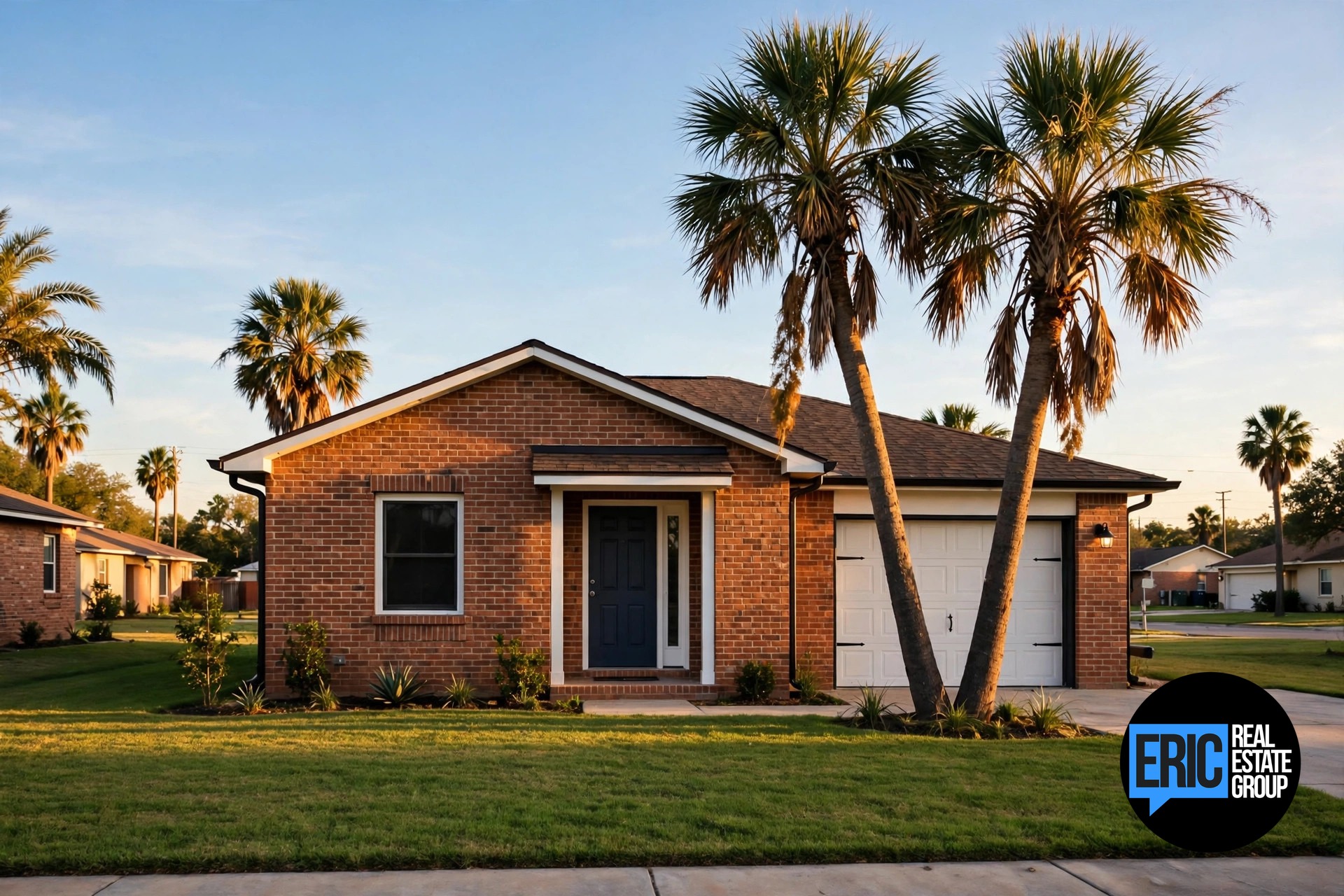
How Much House Can You Afford in the Rio Grande Valley?
Hey, it's Eric.
I hear this question from buyers almost every week: "Eric, how much house can I actually afford here in the Valley?" And I love that question, because it's the right one to ask before you fall in love with a house that's out of reach.
The Rio Grande Valley is one of the most affordable places in Texas to buy a home, which means your money stretches further here than in Austin, Dallas, or Houston. But "affordable" doesn't mean "buy whatever you want." Let me walk you through how lenders actually calculate what you can afford, and how to sanity check that number for yourself.
How Much House Can You Afford: The Short Answer for the RGV
Lenders generally want your total monthly housing payment to land around 28 to 31 percent of your gross monthly income. That's the front end ratio. Your total monthly debts, including the housing payment, car payments, minimum credit card payments, and student loans, should land around 36 to 43 percent of gross income, depending on the loan program. That's the back end ratio.
Here in the Valley, in my experience, most of my buyers end up shopping in the $150,000 to $280,000 range. Say your household brings in $60,000 a year, which is $5,000 a month before taxes. At 28 percent, your max housing payment is about $1,400 a month. That's a hypothetical example, not a quote, but it shows the math.
The 3 Numbers That Decide How Much House You Can Afford
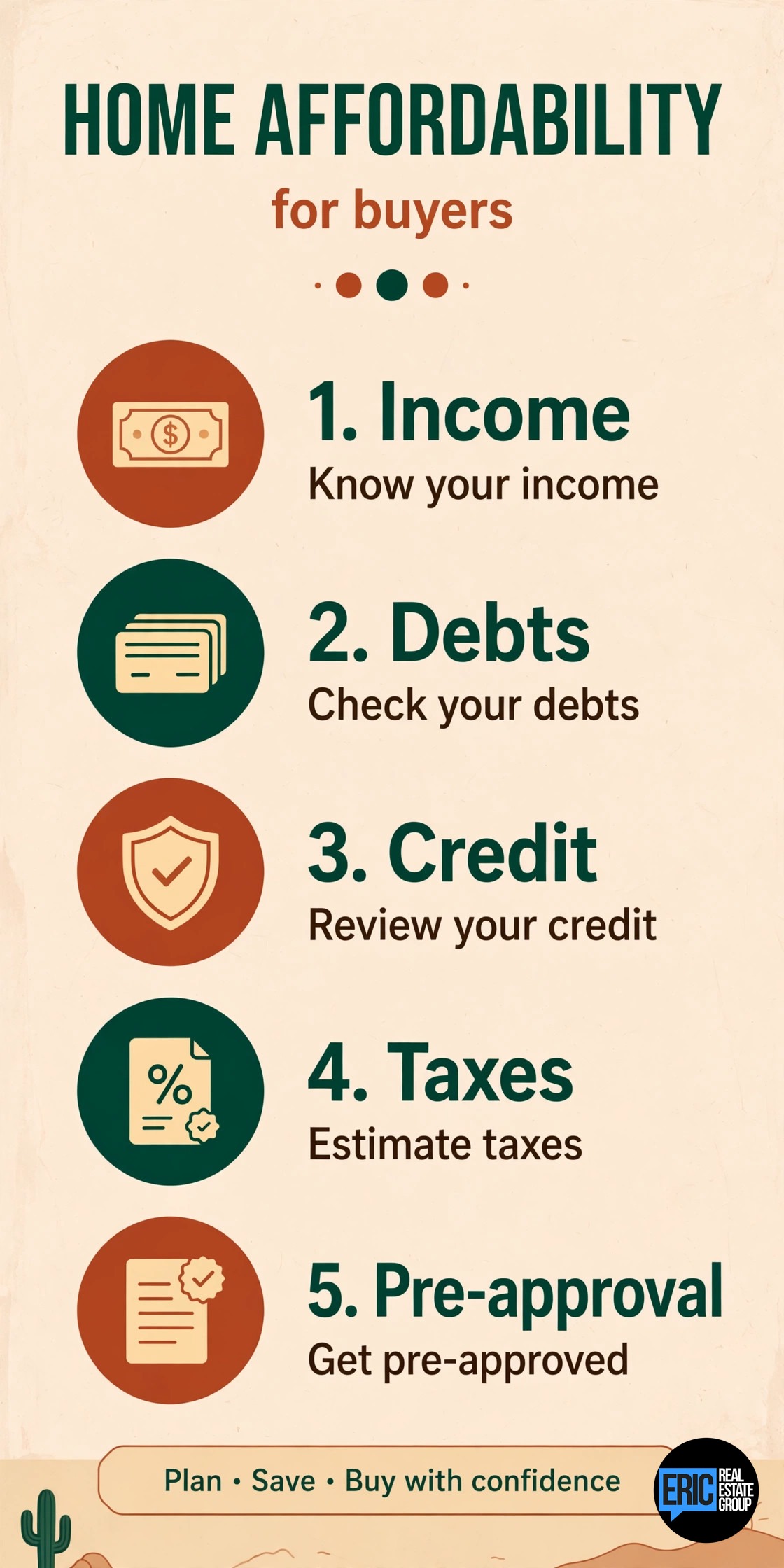
- Your income, verified on paper. Lenders don't go off what you tell them. They go off pay stubs, W2s, and tax returns. If you're self employed, they'll usually want two years of tax returns, and they'll use your net income after deductions, not your gross revenue. This catches a lot of my self employed buyers off guard. If your tax returns show $45,000 but you feel like you make $70,000, the lender sees $45,000.
- Your debts. Pull your real monthly minimums: car note, credit cards, student loans, child support, any personal loans. Lenders count the minimum payment, not the balance. A $400 car payment can knock tens of thousands off your buying power. In my experience, the buyers who qualify for the most house are the ones with the least monthly debt, even more than the ones with the biggest income.
- Your credit score. Your score decides which loan programs you qualify for and what rate tier you land in. Conventional loans generally want at least 620, and FHA loans can go down to 580 for 3.5 percent down. Higher scores unlock better rates, which directly raises the price of the home you can afford.
Don't Forget the RGV-Specific Costs
This is the part national affordability calculators get wrong for the Valley. Your monthly payment here isn't just principal and interest. It's PITI: principal, interest, taxes, and insurance.
- Property taxes. Texas has no state income tax, so property taxes do the heavy lifting. In Hidalgo County, effective rates vary by city and school district. Budget around 2 percent of the home's value per year as a planning number, and verify the exact rate on any home you're considering. On a $220,000 home, that's roughly $360 a month just in taxes. Big line item.
- Homeowner's insurance. Get a real quote during your option period. Rates vary a lot by home age, roof condition, and flood zone.
- Flood insurance. Parts of the Valley sit in flood zones. If the home you want requires flood insurance, that can add $100 to $300 or more a month. Always check the flood map before you write an offer.
- HOA dues. Many newer subdivisions in McAllen, Edinburg, Pharr, and Weslaco have HOAs. Lenders count the monthly dues against your ratios, so a $150 monthly HOA is $150 less house you can buy.
- PMI or MIP. If you put less than 20 percent down on a conventional loan, private mortgage insurance gets added to your monthly payment until you build enough equity. FHA loans have their own mortgage insurance that lasts for the life of the loan in most cases.
A Simple Walkthrough: How Much House Can You Afford in the RGV?
Let's work a hypothetical example, step by step, for a buyer in Edinburg.
- Household gross income: $72,000 a year, or $6,000 a month
- Monthly debts: $380 car payment, $90 in credit card minimums, no student loans
- Down payment saved: $15,000
- Credit score: 680
Step 1: Max housing payment at 28 percent of income: $6,000 x 0.28 = $1,680 a month.
Step 2: Max total debt payment at 40 percent of income: $6,000 x 0.40 = $2,400 a month. Subtract the $470 in non housing debts, and you're left with $1,930 for housing. The tighter number controls, so $1,680 is the cap.
Step 3: Subtract the non loan costs. Say taxes run $330 a month, insurance $130, and HOA $60. That's $520. That leaves about $1,160 a month for principal, interest, and mortgage insurance.
Step 4: Work backward to a purchase price. In a typical rate environment, $1,160 a month for principal and interest supports roughly a $190,000 to $210,000 loan. Add the $15,000 down payment, and this buyer is shopping roughly in the $200,000 to $225,000 range.
That's the method. Run your own numbers with your real income, your real debts, and real quotes for taxes and insurance, and you'll land on an honest number.
Get Pre-Approved Before You Shop (Seriously)
An online calculator is a starting point, not an approval. A real pre-approval from a local lender tells you the exact loan programs you qualify for, your real interest rate based on your actual credit pull, and the maximum purchase price the underwriter will sign off on.
In my experience, Valley sellers and listing agents take pre-approved buyers far more seriously, especially in competitive price ranges in McAllen and Mission. Get pre-approved with a lender who knows the RGV market, because local quirks like flood zones and rural USDA eligibility can affect your loan.
Smart Ways to Afford More House in the Valley
- Pay down the car before you buy. Killing a $400 monthly payment can add tens of thousands to your buying power.
- Hold off on new debt. No new cars, no furniture financing, no new credit cards between pre-approval and closing.
- Consider USDA areas. Parts of the Valley outside the main cities qualify for USDA loans with zero down.
- Shop your insurance. A few hundred dollars a year difference in homeowner's insurance is real money in your monthly ratios.
The Bottom Line
How much house can you afford in the Rio Grande Valley? As much as your income, debts, credit, and the real local costs support. Run the math honestly, get pre-approved with a local lender, and shop with confidence instead of guessing.
Looking to buy or sell in the Rio Grande Valley?
Eric Jimenez | Eric Real Estate Group, LLC | 956-292-4500 | eric@bettercalleric.com | bettercalleric.com
Better Call Eric. Listings that sell.