


Hey, it's Eric.
Selling land is not the same as selling a house, and a lot of Valley owners learn that the hard way. There is no kitchen to stage, no open house crowd walking through bedrooms, and buyers are looking at potential, utilities, and restrictions more than paint colors. If you own a vacant lot or a piece of land in McAllen, Edinburg, Mission, Pharr, Weslaco, or San Juan and you are thinking about selling, this guide walks through how pricing and marketing actually work for land here in the Rio Grande Valley.
This is general information about how land sales usually work in Texas, not legal or tax advice. Every parcel is different. If you have questions about title, surveys, easements, or taxes, talk with a Texas real estate attorney or your title company before you list.
Selling land in the Rio Grande Valley starts with what buyers can actually build
When someone buys a house, they picture living in it. When someone buys land, they picture what they are allowed to build, how much it will cost to get utilities in, and whether the lot will pass lender and city requirements.
That is why your first job as a seller is to make the unknown known. Buyers pay more when they feel confident. They discount heavily when they have to guess.
Before you price or list, gather what you can:
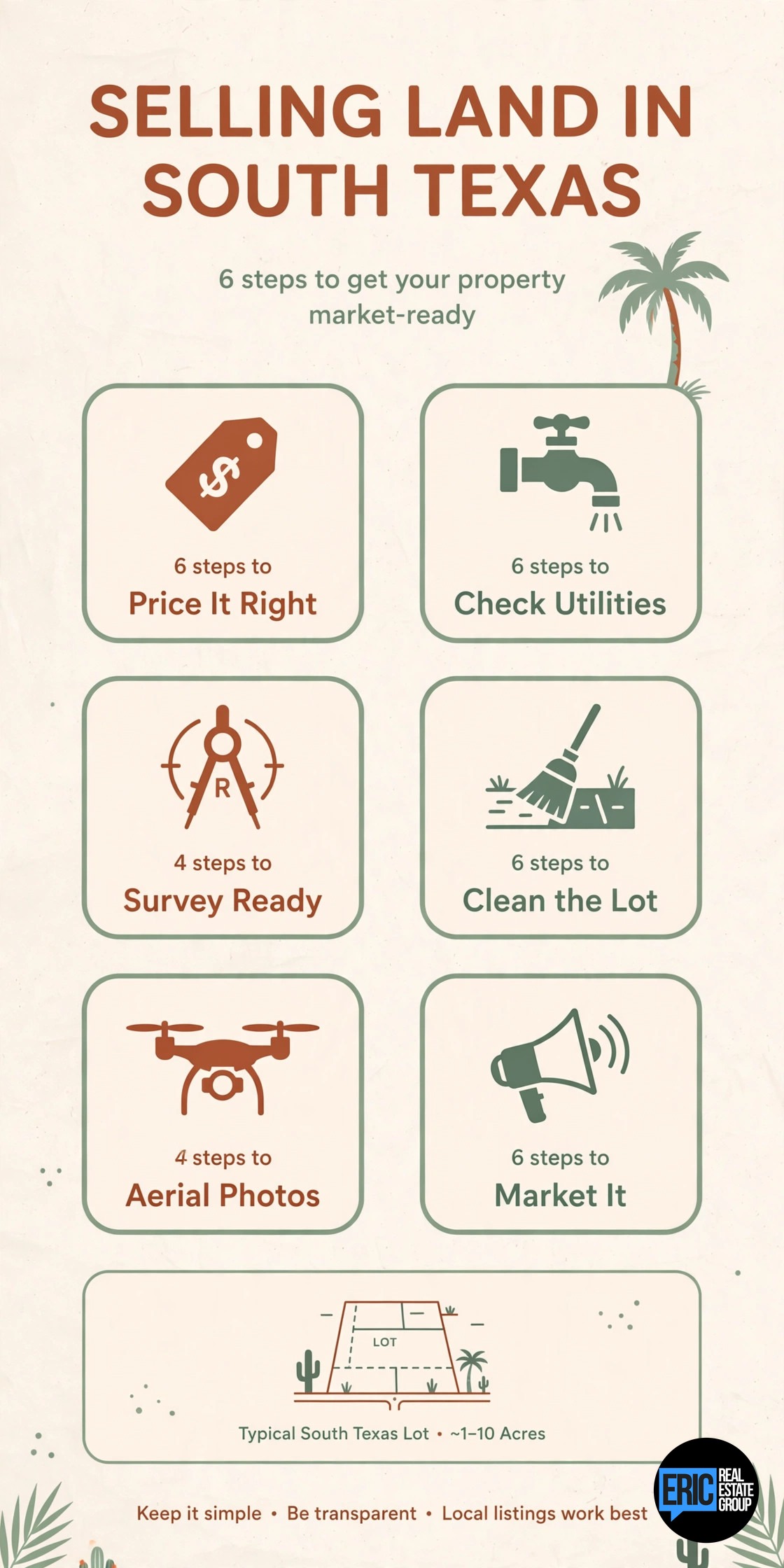
- Survey and legal description, including lot size and dimensions
- Whether the land is inside city limits or in the county, and what that means for permits
- Utility availability: water, sewer or septic, and electric, and where the nearest connections are
- Flood zone status and whether flood insurance would likely be required for a future build
- Zoning and any deed restrictions or HOA rules that limit what can be built
- Road access: paved road, caliche, easement access, or direct frontage
- Any easements, encroachments, or shared driveways that affect use
- Property tax status and whether taxes are current
I cover a lot of the buyer side questions in Buying Land in the Rio Grande Valley: What to Know Before You Build. Read it like a seller. Every question a smart buyer asks there is something you should try to answer in your listing.
How to price land and lots in the RGV without guessing
Pricing land is different from pricing a house. With a house I can look at beds, baths, square footage, and recent sales on the same street. With land, the value turns on location, size, utilities, flood status, and buildability, and comparable sales can be spread out.
Here is how I approach it in my experience:
First, look at recent land sales that are truly comparable, not just nearby. A half acre lot with city water and sewer in Edinburg is not comparable to a half acre lot outside city limits with no utilities, even if they are a mile apart. Adjust for utilities, flood zone, road frontage, and restrictions.
Second, think in price per acre for larger parcels and price per lot or per front foot for smaller residential lots, depending on how buyers in that area usually shop. Your realtor should show you which method local buyers and appraisers are actually using for your type of land.
Third, factor in what a buyer still has to spend. If a lot needs a water tap, septic system, electric run, or fill work because of drainage, a buyer will subtract that cost and the hassle from what they are willing to pay. A lower priced lot with utilities ready can sell faster than a higher priced lot that looks cheaper on paper but needs work.
As a hypothetical example, imagine two similar lots in Weslaco. One has city utilities at the street, a clean survey, and no flood insurance requirement for a future home. The other needs a septic system and sits partly in a flood zone. Even if they are the same size, the first lot will usually draw stronger offers because the build path is clearer.
If you want a data driven starting point for any property you own, the same thinking I use in How to Price Your RGV Home Right: What the Data Says applies here too: price from real comparable sales, not from what you paid years ago or what a neighbor says they would ask.
Prep work that helps a lot sell faster
Land does not need staging, but it does need prep. A lot that looks cared for and is easy to walk sells better than one that looks forgotten.
Practical prep that helps in the Valley:
- Mow, clear brush, and remove trash, old tires, and debris
- Mark the corners if you can find survey pins, so buyers can see the boundaries
- Make access easy and safe, and note where a buyer should park or enter
- Put up a clear sign with a phone number, especially on roads with steady traffic
- Gather documents in one folder: survey, tax certificate if you have it, utility letters, and restriction copies
- If you have a recent survey or soil information, say so in the listing instead of making buyers wonder
Heat matters here too. In South Texas, a buyer walking a lot at midday with no shade and tall brush will rush. A clean, mowed lot they can walk in the morning will hold their attention longer, and that attention turns into offers.
Marketing land the right way: photos, maps, and the right buyers
Good marketing for land looks different from marketing for a house. A single front photo of grass does not sell a lot.
Strong land marketing in my experience includes:
- Drone or aerial photos that show the lot shape, surrounding homes, and nearby roads
- A map or plat image with the lot highlighted, so buyers understand location at a glance
- Ground photos from each corner looking across the parcel
- Clear listing copy that states size, dimensions, utilities, zoning or restrictions, flood status, and possible uses, without promising a use you have not verified
- Targeted reach to builders, investors, and families looking to build, not just general home shoppers
Be careful not to overpromise. Do not say a lot is ready to build, suitable for a septic system, or approved for a certain use unless you have documentation. Say what you know, label what you do not know, and invite buyers to verify with the city or county. That honesty protects you and builds trust.
Pricing and presentation work together. I explain how value is judged in What Is My McAllen Home Worth? How Realtors Run the Numbers, and while that post is about homes, the same lesson holds for land: buyers pay for clarity, condition, and location they can verify.
Who buys lots in the Valley and how financing changes the deal
Your likely buyer shapes your strategy.
- A family buying one lot to build a home later often needs time to check utilities, builders, and financing
- A local builder buying lots looks hard at build cost, flood status, and how fast homes are selling nearby
- An investor buying larger acreage focuses on access, division potential, and long term area growth, and will ask about restrictions early
- A neighbor buying the lot next door can sometimes be your simplest buyer, because they already know the area and the value of extra space
Financing for land is not the same as a regular home loan. Many land purchases are cash, or use land specific loans with different down payment and term expectations than a typical mortgage. That means your buyer pool can be smaller and your days on market can be longer than for a house. Price and patience both matter. Do not panic and cut price in week one if your marketing is strong, but do not ignore feedback either. If every buyer says utilities are unclear, fix the information. If every offer cites flood cost, revisit price with real data.
Common mistakes land sellers make in the RGV
- Pricing from acreage alone and ignoring utilities, flood zone, and access
- Listing with no survey, no map, and one blurry photo
- Letting brush and trash hide the lot so buyers cannot walk it
- Promising a build or use without checking zoning and restrictions
- Forgetting about easements or access issues until title work starts
- Waiting to check taxes or title problems until you are already under contract
Most of these are fixable before you list, with one survey folder, one utility check, and one honest pricing conversation.
The bottom line for selling land in the Valley
Selling land or a lot in the Rio Grande Valley works best when you price from real comparable land sales, prove what can be built and what utilities are available, clean up the parcel so buyers can see it, and market with aerials, maps, and clear facts. Buyers for land pay for confidence. Give them documents, boundaries, and answers early, and you will separate your lot from the listings that make them guess.
If you own a lot or land in McAllen, Edinburg, Mission, Pharr, Weslaco, or anywhere in the Valley and you want to talk through pricing, utilities, and who your best buyer is likely to be, I will walk the property with you, review what you have, and build a marketing plan that fits that specific parcel. No pressure, just a clear next step.
Looking to buy or sell in the Rio Grande Valley?
Eric Jimenez | Eric Real Estate Group, LLC | 956-292-4500 | eric@bettercalleric.com | bettercalleric.com
Better Call Eric. Listings that sell.
Start Your Search: Rio Grande Valley Homes for Sale
Reading about the market is smart. Looking at real homes is better. Try one of these searches, then create a free account to save your favorites and get new listings emailed to you the moment they hit the market.
- Homes for sale in McAllen
- Homes for sale in Weslaco
- Search all Rio Grande Valley homes
- Find out what your home is worth
See a home you like? Call Eric Jimenez at 956-292-4500 and I will set up a showing.