


Hey, it's Eric.
Most buyers I talk to have heard of FHA loans and VA loans. Far fewer have heard of the USDA loan, and that's a shame, because for the right buyer in the right part of the Valley, it's one of the best deals in home buying: a zero down payment mortgage with no monthly mortgage insurance. If you've been renting because saving a down payment feels impossible, keep reading.
The USDA loan program exists to help moderate income buyers purchase homes in eligible rural and suburban areas. And here's the thing about the Rio Grande Valley. While the dense cores of McAllen, Edinburg, and Mission generally don't qualify, a lot of the Valley does. The outskirts, the smaller towns, and the unincorporated communities across Hidalgo and Cameron counties can be USDA eligible. I've watched buyers who assumed they'd need 10 or 20 percent down discover they could buy with nothing down, simply because of where they shopped.
This guide covers how USDA loans in Texas work, who qualifies, what the property rules look like, and how to use this program right here in the RGV.
What Is a USDA Loan?
A USDA loan is a mortgage backed by the U.S. Department of Agriculture. Yes, the agriculture department. The program was created to support homeownership in rural communities, and the eligibility map covers far more places than most people expect. This isn't about buying a farm. Most USDA buyers in the Valley are purchasing regular single family homes in quiet neighborhoods a short drive from the city.
There are two flavors. The most common is the USDA Guaranteed loan, where a regular mortgage lender makes the loan and the USDA guarantees it, which lets the lender offer great terms. There's also a USDA Direct loan, which comes straight from the USDA and is aimed at lower income buyers. For most buyers I work with, the Guaranteed loan through a local lender is the path.
The headline benefit is simple: zero down payment. Not 3.5 percent like FHA. Zero. In my experience, this changes the timeline for a lot of Valley families. Instead of spending three more years saving for a down payment, they're buying now.
The second big benefit: no private mortgage insurance. Most zero or low down payment loans charge you a monthly fee for mortgage insurance. USDA doesn't. Instead there's a guarantee fee, an upfront fee that most buyers roll into the loan amount, plus a smaller annual fee that's folded into the monthly payment. It works out to a meaningful monthly savings compared to the mortgage insurance on a low down conventional loan.
Rates on USDA loans are typically competitive too. When I tell buyers to get quotes on both USDA and FHA side by side, the USDA option often wins on the monthly payment for eligible properties.
USDA Loan Requirements Texas Buyers Should Know
The home has to be in an eligible area. This is the big one. The USDA publishes an eligibility map, and the rules are address by address, not city by city. As a general pattern in the Valley, the denser city centers are usually ineligible while areas just outside them often qualify. But you can't guess from the city name. A home on the edge of town can qualify while one five minutes closer to downtown doesn't. The fix is easy. The USDA's official map lets you type in any address, and any lender who does USDA loans can check an address in seconds. Before you fall in love with a home, check the address.
It has to be your primary residence. USDA loans are for the home you'll live in. No investment properties, no second homes you visit twice a year.
The property has to meet condition standards. The USDA wants the home to be safe, sanitary, and structurally sound. The appraisal includes a condition check along the lines of a sound roof, working plumbing and electrical, and no major health or safety hazards. This protects you, and I still recommend a full independent home inspection on top of it, just like I do for every buyer.
Income limits apply. USDA loans are meant for moderate income households, so the program sets income limits based on household size and the county. The limits are more generous than most people expect, and they account for the number of people in the household. Don't assume you earn too much. I've seen buyers who thought they'd never qualify get approved. A lender who runs USDA loans can check your income against the current limits quickly.
Credit and income guidelines come from the lender. The USDA doesn't set a hard minimum credit score, but every lender has their own standards for USDA files. In my experience, buyers with steady employment and reasonable credit history get approved in the Valley every week. If your credit needs work, ask a lender for a plan. A few months of targeted cleanup can move the needle a lot.
Why USDA Loans Fit the RGV Market So Well
The Valley is practically built for this program. Our home prices are among the most affordable in Texas, and our geography is a patchwork of cities, colonias, and open land. That patchwork means eligible addresses are everywhere once you look past the city cores.
Think about where first time buyers are actually shopping: the newer subdivisions on the edges of town, the established neighborhoods in smaller communities, the quieter streets outside the busiest corridors. A lot of those areas fall in USDA territory. And when you pair an affordable Valley home price with zero down, the monthly payment math works for working families in a way it doesn't in most of Texas.
This program is also a natural fit for buyers looking at the Valley's growth areas. As McAllen, Edinburg, Weslaco, and the surrounding towns keep expanding outward, the new construction and newer resale homes on the fringes are often in eligible zones. If you're already shopping the outskirts for more house for your money, you might already be shopping USDA eligible territory without knowing it.
A Hypothetical Example, Valley Style
Let's say you're buying a $175,000 home just outside one of the Valley's city centers, in an eligible area. With a conventional loan and a small down payment, you'd need the down payment in cash, plus closing costs, plus monthly mortgage insurance on top of your payment.
With a USDA loan, the down payment is zero. Your cash to close is mostly closing costs, and in our market buyers regularly negotiate seller credits toward those costs. There's no monthly mortgage insurance, just the USDA guarantee fee structure, with the upfront portion typically rolled into the loan. Every file is different and your lender will run your exact numbers, but this is why I tell eligible buyers to price the USDA option before assuming they need years of saving first.
Your Steps to Buy With a USDA Loan in the Valley
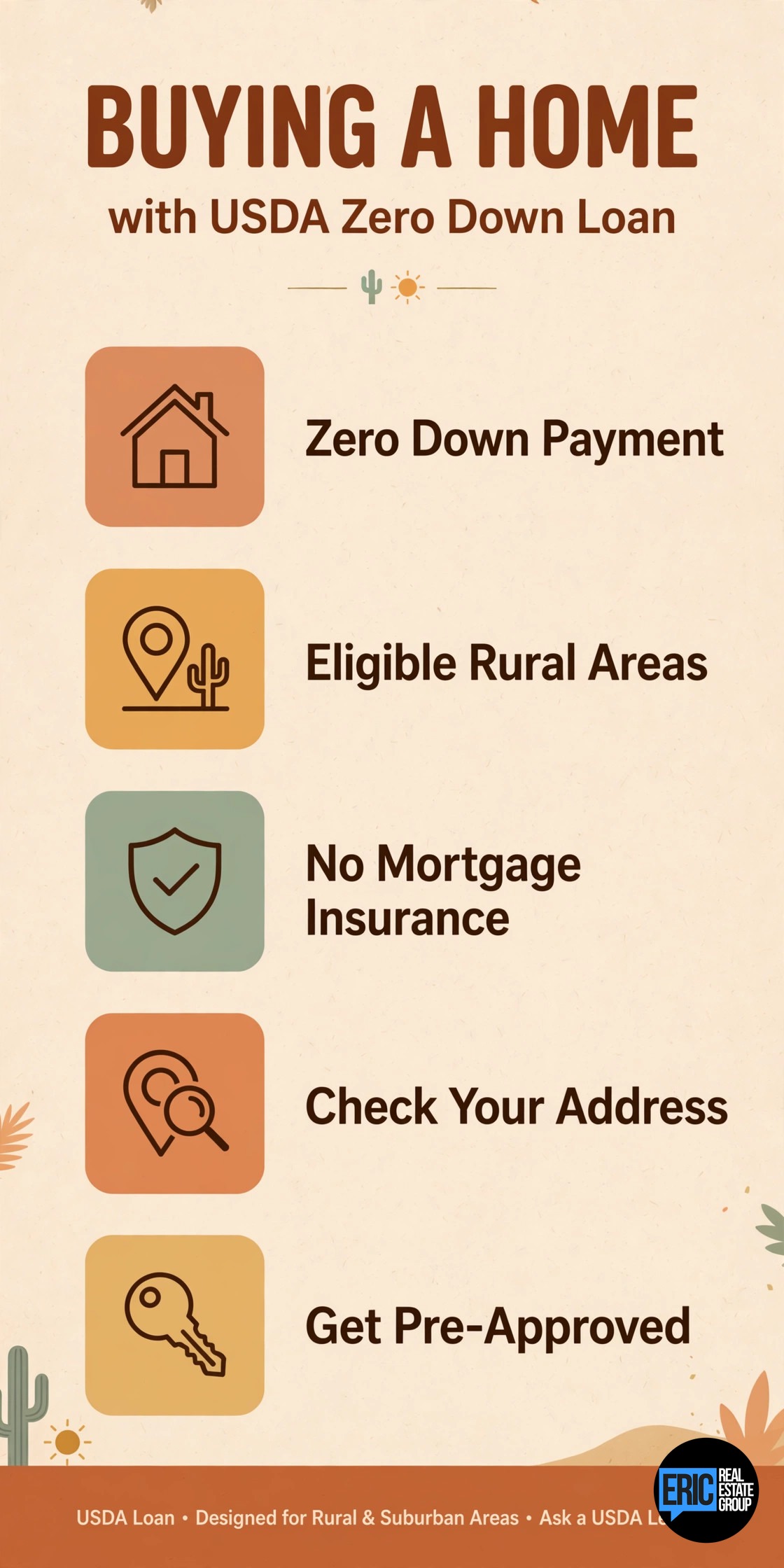
- Check the address first. Before anything else, verify the home's address on the USDA eligibility map or ask your lender. This is the gate. Everything else follows.
- Choose a lender who closes USDA loans regularly. This matters. USDA files have their own appraisal quirks and a two stage underwriting process, with the lender's underwriting plus a USDA review. A lender who does these weekly keeps the timeline moving. A lender who rarely touches them can add weeks.
- Confirm your income fits. Have the lender check your household income against the current USDA limits for your county and household size. Don't self disqualify.
- Get a real pre-approval. Sellers in the Valley accept USDA offers every day, and a strong pre-approval letter from a known local lender makes yours stand out, especially in competitive pockets.
- Shop with a realtor who knows the eligible areas. This is where local knowledge pays. I know which corridors and neighborhoods in the Valley tend to be USDA eligible, and I can help you focus your search so you don't waste weekends touring homes that can't use the program.
The Bottom Line
If a down payment is the thing standing between you and homeownership, the USDA loan might be your answer. Zero down, no monthly mortgage insurance, competitive rates, and a program that fits the Rio Grande Valley's geography and prices better than most people realize. The only way to know if it works for you is to check an address and talk to a lender who runs these loans every week.
Don't let the down payment be the reason you keep renting. Let's check some addresses and see what's possible.
Looking to buy or sell in the Rio Grande Valley?
Eric Jimenez | Eric Real Estate Group, LLC | 956-292-4500 | eric@bettercalleric.com | bettercalleric.com
Better Call Eric. Listings that sell.