


Hey, it's Eric.
The Rio Grande Valley is home to a lot of veterans and active duty military families. I work with them every year, and if there's one home buying tool that doesn't get enough attention here, it's the VA home loan. If you served, you earned one of the strongest mortgage benefits in the country, and in a market as affordable as ours, a VA home loan in Texas can take you from renting to owning with less cash out of pocket than most buyers expect.
This guide walks through how VA home loans work, who qualifies, what the requirements look like for Texas buyers, and how to use your benefit right here in the Valley, from McAllen to Brownsville.
What Makes a VA Loan Different
A VA loan is a mortgage backed by the U.S. Department of Veterans Affairs. The VA doesn't lend you the money directly. A private lender makes the loan, and the VA guarantees part of it, which is why lenders can offer terms you won't find on a conventional loan.
The headline benefit is the down payment. Eligible buyers can purchase a home with zero down payment. In my experience, this is the single biggest reason veterans in the RGV buy sooner than they planned. Saving 10 or 20 percent for a down payment takes years for most families. With a VA loan, that barrier is gone.
There are two more advantages worth knowing. VA loans have no private mortgage insurance, which is a monthly charge most low down payment conventional borrowers have to pay. And VA loan rates are typically competitive, often better than what the same buyer would get on a conventional loan. I always tell veteran buyers to compare a VA quote side by side with any other quote they get. The VA option usually wins.
One more thing buyers love. Your VA benefit is reusable. You can use it more than once in your lifetime, and in many cases you can have more than one VA loan at a time if you have remaining entitlement. Ask your lender to walk you through your entitlement. It's simpler than it sounds.
Who Qualifies for a VA Home Loan
Eligibility generally covers veterans, active duty service members, members of the National Guard and Reserves who meet service requirements, and some surviving spouses of veterans. The exact service requirements depend on when and how long you served.
The key document is your Certificate of Eligibility, usually called the COE. It proves to your lender that you qualify for the benefit. In my experience, a good VA lender can pull your COE quickly, often the same day you apply, through the VA's online system. Some buyers get it themselves through the VA's website or by mail, but letting your lender handle it is usually faster.
If you're not sure whether you qualify, don't guess. A lender who does VA loans every week can check your eligibility in minutes. I've seen buyers assume they didn't qualify because of a short service stint or an old discharge question, then learn they were eligible all along.
VA Home Loan Requirements Texas Buyers Should Know
The VA sets the big picture rules. Your lender sets the fine print. Here's what that looks like in practice.
It has to be your primary residence. VA loans are for the home you will actually live in. You can't use one for a pure investment property or a vacation home you never occupy.
The home must pass a VA appraisal. The VA requires an appraisal that covers both value and condition. The appraiser checks that the home meets the VA's minimum property requirements, things like a sound roof, safe electrical and plumbing, and no major health or safety hazards. This is not a home inspection, and I still recommend every buyer get an independent inspection too. But the VA's condition check protects you from buying a home with serious problems.
Credit and income guidelines come from the lender. The VA itself does not set a minimum credit score, but every lender has their own standards. In my experience, veterans with steady income and reasonable credit history get approved every day in the Valley. If your credit needs work, a few months of cleanup can make a real difference, and a good lender will tell you exactly what to fix.
There is a one time funding fee. Most VA borrowers pay a VA funding fee, which helps keep the program running for future veterans. The fee is a percentage of the loan amount and it varies based on factors like your down payment and whether it's your first VA loan. You can usually roll it into the loan instead of paying it at closing. Some veterans, including those with certain service connected disability ratings, are exempt from the fee entirely. Ask your lender for the current fee for your situation, since the exact numbers are set by the VA and can change.
Why VA Loans Fit the RGV Market So Well
Here's what I see in our market. Home prices in the Rio Grande Valley are among the most affordable in Texas. When you pair affordable prices with a zero down payment loan, the monthly math works for a lot of military families, including young families buying their first home.
VA loans work for resale homes, which make up most of our market, and for new construction too. If you're looking at a condo or townhome, one extra wrinkle. The complex generally needs to be on the VA's approved list. Your lender can check this fast, so ask before you fall in love with a unit.
Texas also has state level programs for veterans through the Texas Veterans Land Board, which some buyers combine with their federal VA benefit. I'm a realtor, not a lender, so I won't pretend to know every detail of those programs. But if you're a Texas veteran, it's worth asking your lender whether a state program could sweeten your deal.
A Hypothetical Example, Valley Style
Let's say you're a veteran buying a $200,000 home in Edinburg. With a conventional loan and a small down payment, you'd need the down payment plus closing costs in cash, and you'd likely pay private mortgage insurance every month.
With a VA loan, the down payment drops to zero. Your cash to close is mostly closing costs, and in our market buyers often negotiate seller credits toward those costs. Your monthly payment has no mortgage insurance tacked on. Every loan file is different, and your lender will give you exact numbers, but this is why I tell every eligible buyer I meet to price out the VA option before assuming anything.
Your Steps to Use a VA Loan in the Valley
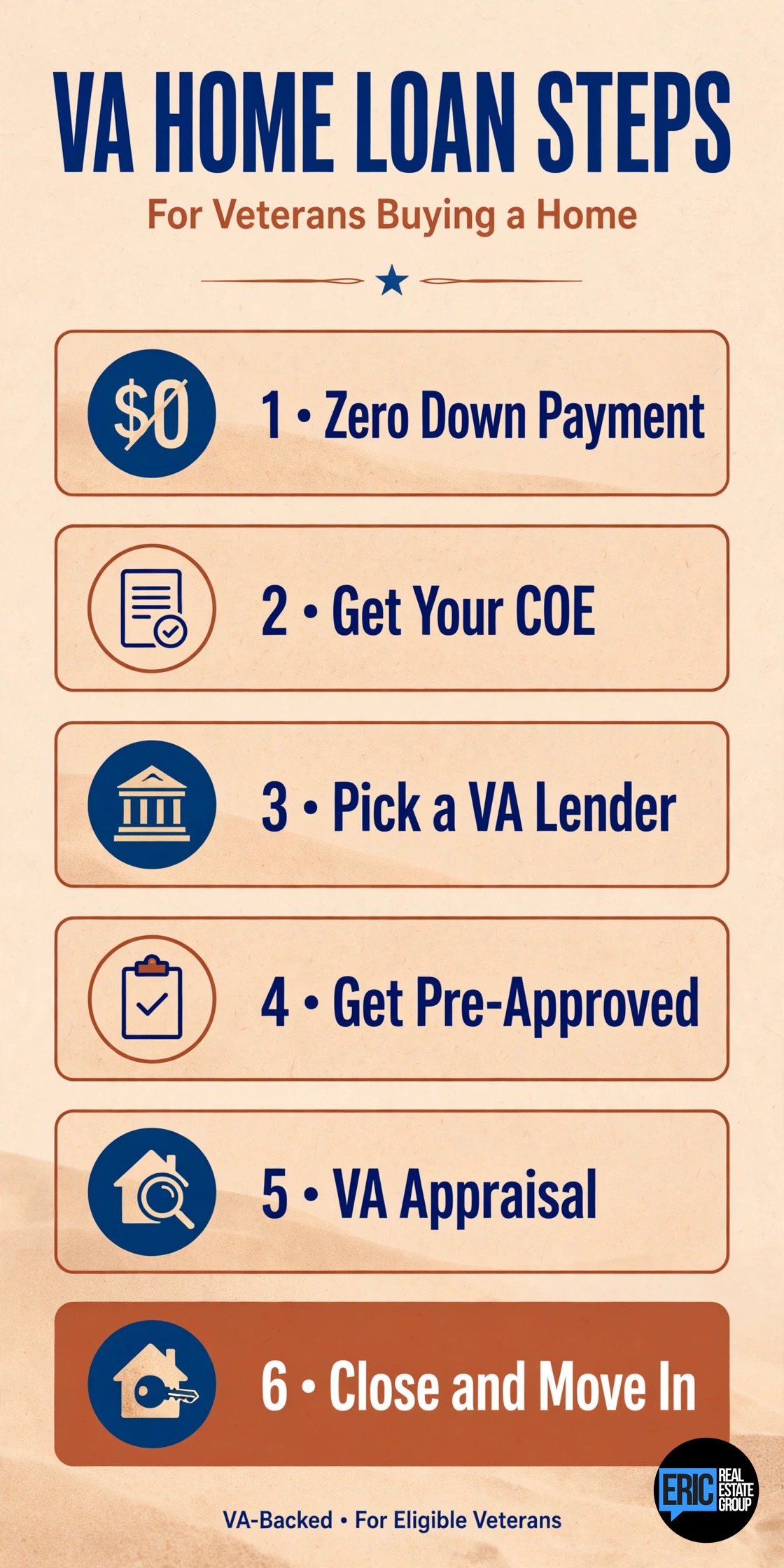
- Get your Certificate of Eligibility. Your lender can usually pull it the same day. Don't let paperwork be the reason you wait.
- Choose a lender who does VA loans regularly. This matters more than most buyers realize. A lender who closes VA loans every week knows the appraisal process, the funding fee, and the entitlement math. A lender who rarely touches VA loans can slow your file down.
- Get a real pre-approval, not just a pre-qualification. Sellers in the RGV take VA offers seriously when they come with a strong pre-approval letter from a known local lender.
- Shop with a realtor who knows VA transactions. VA appraisals and the VA's condition requirements create a few quirks, like how repair requests get handled. I've closed VA deals across the Valley, and I know how to keep them on track. This is my lane.
- Make an offer and let the process work. Your lender orders the VA appraisal, underwriting verifies your file, and you close like any other buyer. From contract to keys, a VA purchase in our market typically moves on a normal timeline when the lender and realtor know the program.
The Bottom Line
If you served our country, the VA home loan is a benefit you earned, and it might be the most powerful home buying tool available to you. Zero down payment, no mortgage insurance, competitive rates, and a benefit you can reuse. In an affordable market like the Rio Grande Valley, that combination puts homeownership within reach for more veteran families than most people realize.
Don't leave this benefit on the table. Talk to a VA experienced lender, get your COE, and let's go find your home.
Looking to buy or sell in the Rio Grande Valley?
Eric Jimenez | Eric Real Estate Group, LLC | 956-292-4500 | eric@bettercalleric.com | bettercalleric.com
Better Call Eric. Listings that sell.