


What Are Closing Costs in Texas? A Buyer's Line by Line Breakdown
Hey, it's Eric.
One of the most common questions I get from buyers, especially first time buyers here in the Rio Grande Valley, is: "What are closing costs in Texas, and how much do I need to save?" Most people know they need a down payment. Far fewer know there's a second pile of money due at the closing table. Let's break closing costs in Texas down line by line, in plain English, so nothing surprises you.
What Are Closing Costs, Exactly?
Closing costs are the fees and prepaid expenses you pay to finalize your home purchase: everything it takes to get the loan funded, the title transferred, and the property legally in your name. They are separate from your down payment. In my experience, RGV buyers are surprised twice: once when they learn closing costs exist, and again when they see how many line items there are. On a hypothetical $200,000 home in Weslaco or San Juan, the total could be several thousand dollars on top of your down payment. I'm not giving you a guaranteed number because every deal is different. Here's the full list of where that money actually goes.
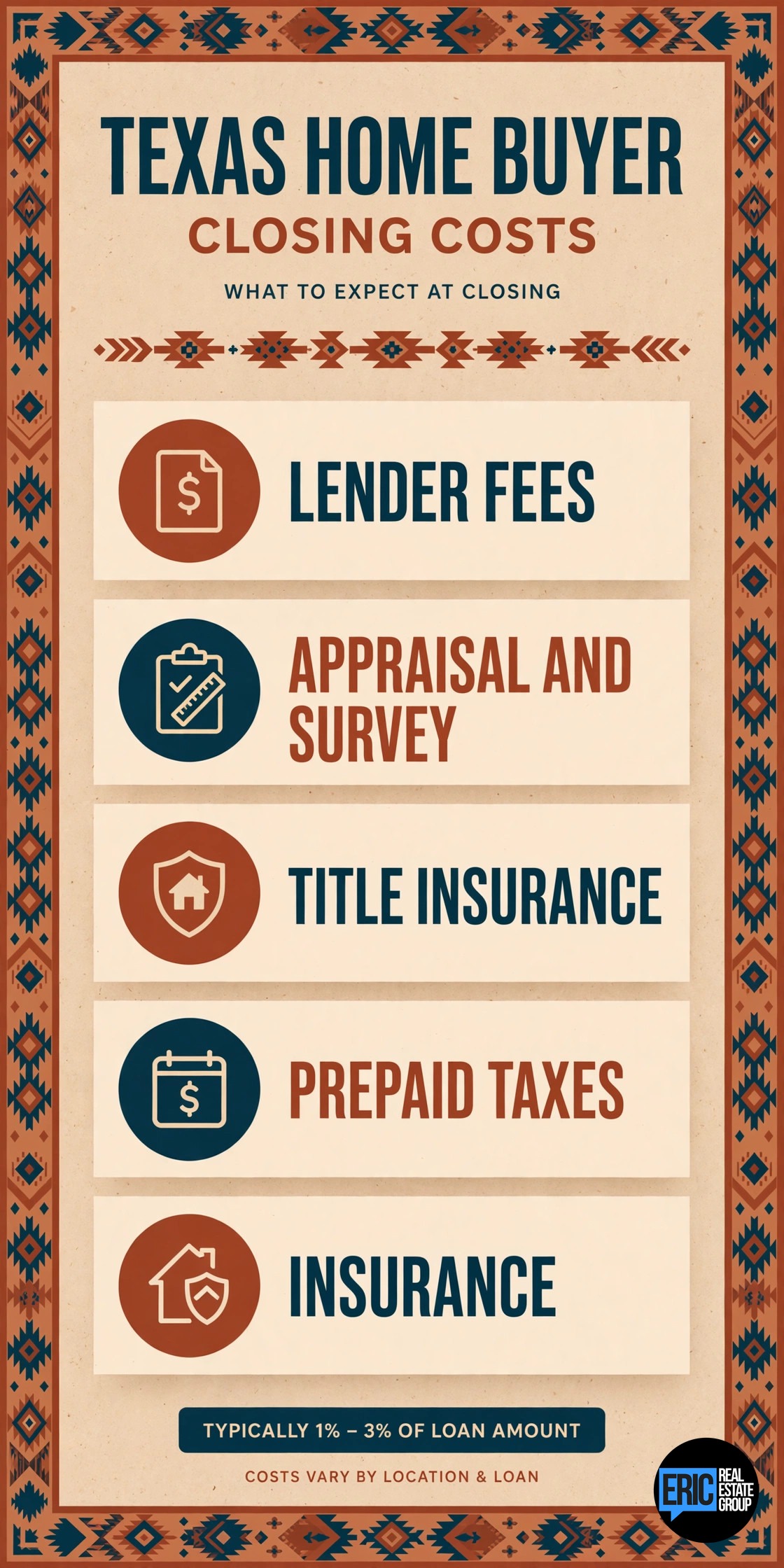
Lender Fees
Your lender charges for making the loan happen. You'll see these on your loan estimate under origination charges.
- Origination fee. The lender's charge for processing and underwriting your loan. Sometimes a flat fee, sometimes a percentage. Always ask what it covers, because lenders itemize differently.
- Discount points. Each point usually equals 1% of the loan amount and buys your rate down a little. Points are optional. In my experience, most RGV first time buyers skip them and keep their cash, because the savings take years to pay back. Ask your lender for the break even math.
- Application and processing fees. Small charges some lenders add for the application, underwriting, or credit report.
Third Party Services
These are services your lender requires from outside companies before they'll fund the loan.
- Appraisal. An independent appraiser values the home to make sure it's worth what you're paying. The lender orders it, you pay for it, usually a few hundred dollars in my experience around the Valley.
- Credit report fee. A small charge for pulling your credit.
- Survey. In Texas, your lender will almost always require a survey showing the property boundaries. If the seller has a recent one, we may be able to reuse it and save you money. Always ask the listing agent for an existing survey first.
- Home inspection. You pay for the inspection before closing, not at the closing table, but budget for it anyway. A general inspection, plus termite and possibly foundation checks on older Valley homes, is money well spent. I tell every buyer: the inspection is the cheapest insurance in the whole transaction.
Title and Settlement Charges
Texas is a title company state, so a big chunk of your closing costs lives here.
- Title search. The title company digs through county records to make sure the seller actually owns the property and there are no hidden liens.
- Lender's title insurance. Your mortgage company requires a policy protecting their investment. You pay for it, it protects them. In Texas, title insurance rates are set by the state, so the price doesn't vary much between title companies.
- Owner's title insurance. This one protects YOU if someone later claims they have a right to your property. It's a one time premium paid at closing, and I recommend it on every purchase.
- Settlement or closing fee. The title company's charge for running the closing, preparing documents, and handling the money.
- Recording fees. The county charges to record your deed and mortgage in the public records.
Prepaid Expenses and Escrows
These aren't fees at all. They're money you pay ahead of time into an escrow account, or costs that belong to the year you're buying.
- Prepaid interest. Your lender collects interest from the day you close through the end of the month. Closing at the end of the month means less prepaid interest.
- Homeowner's insurance. Your lender requires a full year of homeowner's insurance paid upfront at closing. Get quotes early, because premiums vary a lot near flood zones, which are common in parts of the Valley.
- Flood insurance. If the property sits in a FEMA flood zone, your lender will require a separate flood policy. This is a big deal in the RGV. Check the flood map before you fall in love with a house.
- Property tax prorations. In Texas we pay property taxes in arrears, so at closing we split the current year's taxes between buyer and seller based on who owned the home for which days. This catches more RGV buyers off guard than anything else on this list.
- Escrow deposits. Your lender may require a few months of taxes and insurance held in escrow as a cushion when the loan starts.
The Money You Already Paid
Two items in a Texas contract show up as credits at closing, not new charges.
- Earnest money. The good faith deposit from your offer gets credited toward your closing costs or down payment.
- Option fee. The small amount you paid the seller for your unrestricted right to terminate during the option period. In Texas this goes to the seller and is generally not refunded.
How RGV Buyers Can Lower Their Closing Costs
Here's what I tell my buyers:
- Compare loan estimates. Get quotes from at least two or three lenders and compare them line by line. Lender fees vary more than people think.
- Ask about lender credits. Some lenders will cover part of your closing costs in exchange for a slightly higher rate.
- Negotiate seller concessions. Depending on the market and the deal, the seller may agree to contribute toward your closing costs. There are limits depending on your loan type, so talk to your lender first.
- Reuse the survey. Ask for an existing survey before paying for a new one. This alone can save real money.
- Time your closing. Closing near the end of the month trims prepaid interest.
- Look at assistance programs. Some Texas programs help with closing costs too, not just down payments. If you haven't read my post on Texas down payment assistance, start there.
The Bottom Line on Closing Costs in Texas
Closing costs in Texas aren't a mystery once you see them line by line: lender fees, third party services, title charges, and prepaid expenses, plus Texas specific items like the survey and tax prorations that hit harder here than buyers expect. Your lender must give you a closing disclosure at least three business days before closing. Read it carefully, and call me or your lender the moment something looks off. No question is too small when it's your money on the line.
Looking to buy or sell in the Rio Grande Valley?
Eric Jimenez | Eric Real Estate Group, LLC | 956-292-4500 | eric@bettercalleric.com | bettercalleric.com
Better Call Eric. Listings that sell.