



1031 Exchanges for RGV Investors: Selling a Rental and Deferring the Tax
Hey, it's Eric.
If you own a rental in McAllen, Edinburg, Mission, or Weslaco and you are thinking about selling, the tax bill is probably part of your decision. In my experience, a lot of Valley investors want to sell my house in McAllen style, meaning sell the rental they have, and buy a better rental, but they hesitate because they do not want to hand a big chunk of their gain to taxes in one year. That is where a 1031 exchange comes up. It does not erase tax forever. Done right, it lets you defer tax while you trade one investment property for another.
This post is general information from my experience working with Rio Grande Valley investors, not tax or legal advice. A 1031 exchange has strict federal rules and hard deadlines, and your CPA and a qualified intermediary need to be involved from the start.
Sell my house in McAllen as a rental: what a 1031 exchange actually does
A 1031 exchange, named for Section 1031 of the tax code, lets an investor sell real property held for investment or business use and reinvest the proceeds into like kind replacement property, deferring capital gains tax that would otherwise be due on that sale.
A few plain English points matter most:
- It is a deferral, not forgiveness. The gain follows you into the new property, and tax can come due later when you sell without another exchange.
- Your primary home does not qualify. Both properties need to be held for investment or business use.
- Like kind for real estate is broad. A single family rental in Pharr can generally be exchanged for a duplex in Edinburg or another rental in Mission. Your tax professional confirms what qualifies.
- You cannot just take the cash and shop later.
I explain the tax that sellers are trying to plan around in Capital Gains Tax When Selling Your Texas Home: The Basics. Read that first if you are not sure how the gain on a rental differs from the gain on the home you live in.
The two deadlines you cannot miss
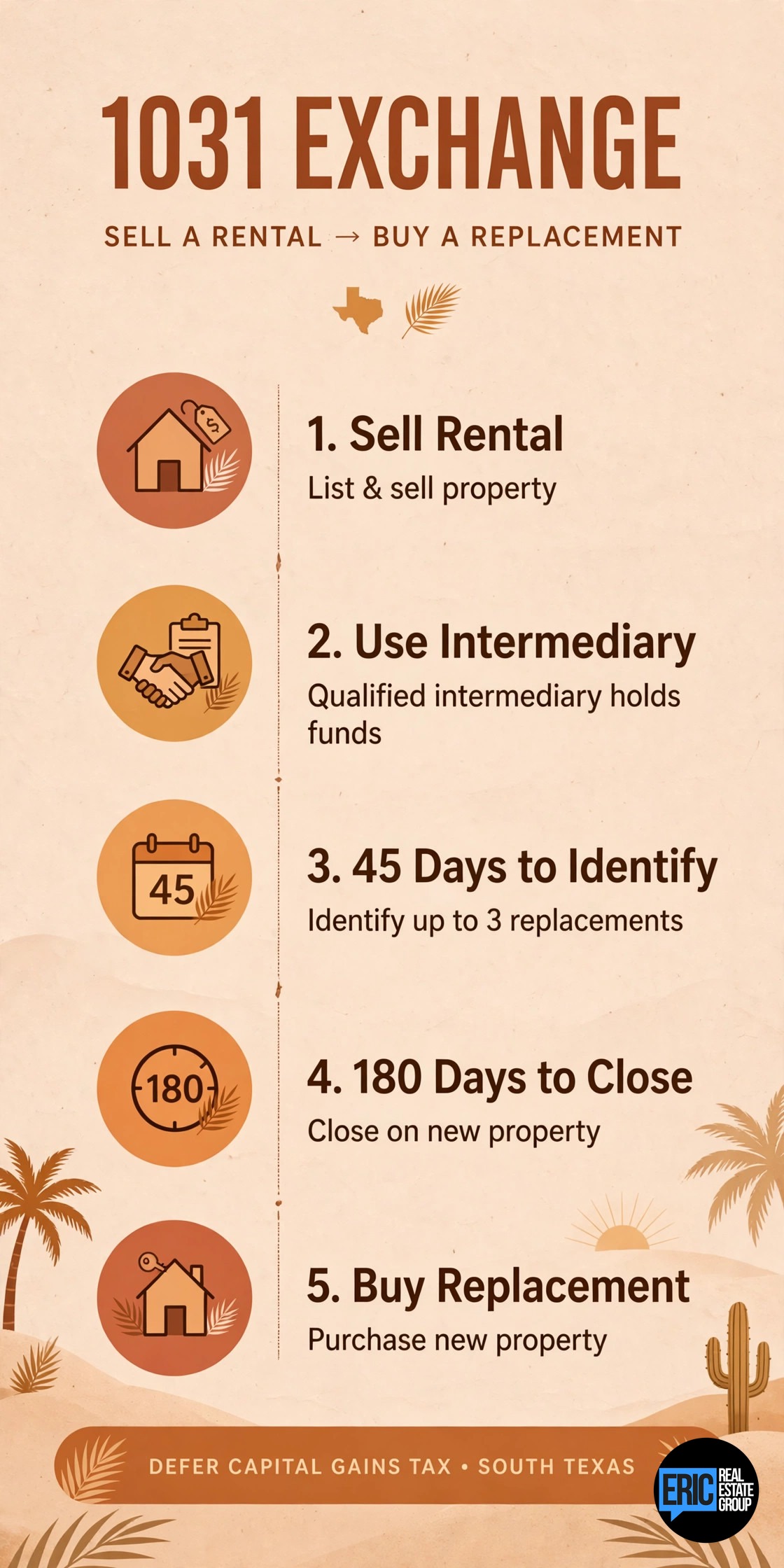
This is the part that decides whether an exchange lives or dies. Once your rental sale closes, the clock starts, and in general terms the standard timelines work like this:
- You have 45 calendar days from closing to identify potential replacement properties in writing, following the identification rules your intermediary gives you.
- You have 180 calendar days from closing to actually close on the replacement property.
Those are calendar days, not business days, and they run at the same time, not one after the other. Weekends and holidays do not pause them in the way many people assume, so do not build a plan that needs an extension you have not confirmed in writing with your tax professional.
In practice here in the Valley, your replacement search starts before your rental even closes. If you wait until after closing to start touring rentals in San Juan or Alamo, you are already burning your identification window. The investors who do this well have a short list, and a backup, before day one.
Why a qualified intermediary has to hold the money
You cannot receive the sale proceeds yourself and still expect the exchange to hold up. A qualified intermediary, an independent third party who handles exchanges, holds the funds between the sale and the purchase and helps with the paperwork and deadlines.
That surprises a lot of first time exchangers, who picture putting the money in their own account for a few weeks and then buying. That direct receipt is exactly what the structure is built to avoid. Line up the intermediary before you list. Your CPA, the intermediary, and your realtor all need the same timeline, because a closing delay on either side can squeeze both deadlines.
To defer the full amount, the replacement usually has to cost as much or more
To defer the entire gain, the replacement property generally needs to cost as much as or more than what you sold, and the equity and financing pieces need to line up too. If you buy for less, or pull cash out, that leftover piece, often called boot, can be taxable even when the rest of the exchange works.
As a hypothetical example, imagine you sell a rental in Weslaco and want to move that value into two smaller rentals in Edinburg and Pharr. The total picture, price, equity, and debt, has to be measured against what you sold. Have that conversation with your CPA before you identify properties, not at the closing table.
If you are still deciding what to buy next, my guide on Buying an Investment Property in the RGV: Rentals, Numbers, and Neighborhoods walks through how I look at rental numbers here in the Valley.
Tenants, timing, and selling a rental that is occupied
A 1031 plan does not pause the human side of the sale. If your rental is occupied, Texas notice rules, the lease terms, and the buyer's plans all affect your showing schedule and your closing date, and that closing date starts your exchange clock.
I covered that side in detail in Selling a Home With Tenants in Texas: Rights, Notice, and Timing. Build that timing into the exchange plan early. A seller who needs extra weeks to deliver a vacant home, or a buyer who needs extra time for financing, can put real pressure on a 45 day identification window if nobody planned for it.
The ordinary selling work still applies:
- Price the rental from comparable sales, not from what you hope the tax savings will add
- Disclose what Texas law requires, in writing, just like any other sale
- Keep rent rolls, leases, and expense records organized for serious buyers
- Decide early whether you will deliver the home vacant or occupied, and price and market it to match
When a 1031 exchange may not be worth it
An exchange is a tool, not a default. It deserves a hard second look when:
- You actually want to exit rentals and take the cash for something that is not replacement real estate
- You cannot find replacement property you genuinely want within the deadlines, and you would be buying a bad deal just to chase a deferral
- The gain is small enough that your CPA says the cost and complexity outweigh the benefit in your situation
- You are selling your primary residence, which is a different tax conversation entirely
Buying a poor replacement property to save tax is still owning a poor property. The real estate has to make sense on its own, in McAllen, Edinburg, Mission, Pharr, Weslaco, or wherever you buy it.
The bottom line for RGV investors
A 1031 exchange can let a Valley investor sell a rental and defer the tax while moving into replacement property, but only inside a strict structure. A qualified intermediary holds the funds, you identify within 45 days, you close within 180 days, and the replacement value has to line up to defer the full amount. Start with your CPA and intermediary before you list, and let the real estate deal, not just the tax deferral, drive the decision.
Thinking about selling a rental in the Rio Grande Valley and buying another? Call me first. We will price the rental you have, map the timeline honestly, and line up the search for what comes next, with your tax professional in the loop from day one.
Looking to buy or sell in the Rio Grande Valley?
Eric Jimenez | Eric Real Estate Group, LLC | 956-292-4500 | eric@bettercalleric.com | bettercalleric.com
Better Call Eric. Listings that sell.
Start Your Search: Rio Grande Valley Homes for Sale
Reading about the market is smart. Looking at real homes is better. Try one of these searches, then create a free account to save your favorites and get new listings emailed to you the moment they hit the market.
- Homes for sale in McAllen
- Homes for sale in Edinburg
- Search all Rio Grande Valley homes
- Find out what your home is worth
See a home you like? Call Eric Jimenez at 956-292-4500 and I will set up a showing.