


Hey, it's Eric.
If you are thinking about selling in McAllen, Edinburg, Mission, Pharr, Weslaco, or San Juan, you have probably asked about capital gains tax when selling your Texas home. It sounds complicated, and many sellers worry they will owe a big tax bill without knowing it ahead of time. I am a realtor, not a tax advisor, so this is the basics in plain English, not tax advice for your situation. I will explain the main ideas so you can have a smarter conversation with your CPA before you list.
Capital gains tax when selling your Texas home, the simple version
A capital gain is basically the profit on paper when you sell for more than your cost basis. Your basis usually starts with what you paid for the home, plus certain closing costs and the cost of major improvements you made while you owned it. You then compare that basis to your sale price, after subtracting selling costs like commissions and other closing expenses.
Here is a hypothetical example, just to show the math idea. Say a seller bought a Valley home years ago, added a major improvement like a roof replacement or a room addition, and later sells for more than the original purchase price. The gain is not simply the sale price minus the purchase price, because the improvement and the selling costs can change the number. That is why records matter.
Texas does not have a state income tax, so for most Valley sellers this is mainly a federal tax question. Federal rules, your income, your filing status, and how you used the home all play a role. Two sellers on the same street can have very different tax results.
If you want to understand the selling costs side first, I break that down in my guide on What Sellers Pay at Closing in Texas: A Clear Breakdown
The primary home exclusion, in plain English
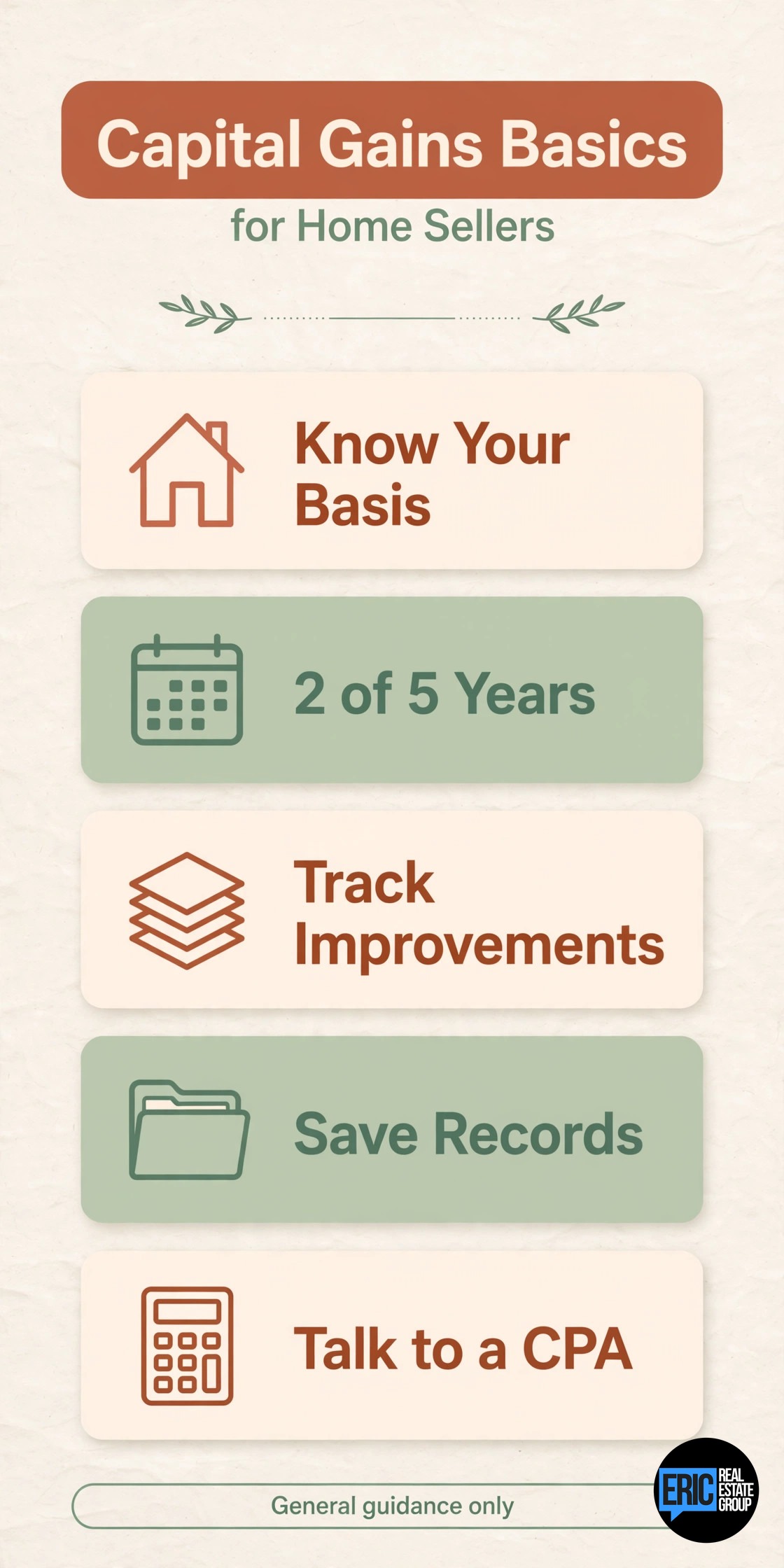
For many homeowners, the most important rule is the primary home exclusion. In general, if you have owned and lived in the home as your main home for at least two of the five years before the sale, you may be able to exclude a portion of the gain from federal income tax. The general exclusion amounts most people hear about are up to 250,000 dollars for a single filer and up to 500,000 dollars for a married couple filing jointly, when all the requirements are met.
Owned and lived in are two separate tests. The two years do not always have to be continuous, and there are special situations for military service, divorce, job moves, and health reasons. There are also limits if you used the exclusion on another home sale recently.
In my experience, many longtime Valley homeowners who sell their main home fall under the exclusion and owe no federal capital gains tax on that sale. But many does not mean everyone. If your gain is large, if you moved out years ago, or if the home was a rental for a period, you need a tax professional to run your exact numbers before you count on the exclusion.
What counts toward your basis and why records matter
Your basis is where good paperwork pays off. Keep records for:
- Your original purchase documents and closing statement
- Major improvements, like a new roof, a room addition, a major kitchen remodel, or a new air conditioning system installed as a capital improvement
- Selling documents, including your closing statement from the sale
- Records that show when the home was your main home and when it was not
Regular repairs are treated differently from capital improvements. Repainting or fixing a small leak is usually maintenance. Adding a room or replacing a major system is more likely an improvement. Save receipts and let your tax professional sort them.
Pricing and value still matter before tax enters the picture. If you are asking what is my McAllen home worth, I explain my process in What Is My McAllen Home Worth? How Realtors Run the Numbers
When RGV sellers get surprised by capital gains
These are the situations where I tell sellers to get tax advice early, before we set a price or sign a contract:
- You have lived in the home for less than two years
- The home was a rental property or a second home for part of the time you owned it
- You inherited the property or received it as a gift
- You are selling after a divorce or the death of a spouse
- Your profit may be larger than the exclusion amount
- You claimed depreciation on the home while it was a rental
Inherited property is a good example of why early advice matters. There is a concept often called a stepped up basis for inherited property, which can change how gain is calculated, but the details depend on how title was held and when. Do not guess on that one.
If you moved out and your old home has sat empty or rented for years, your use test may look very different from a neighbor who lived in their home right up to the sale.
For a broader look at pricing strategy before you list, see my post on How to Price Your RGV Home Right: What the Data Says
Practical steps before you list your Valley home
You do not need to become a tax expert. You do need a short checklist.
First, gather your purchase papers and improvement receipts now, not the week before closing. Second, write down a simple timeline of when you bought the home, when you lived in it, and when it was rented or vacant. Third, ask your CPA or tax advisor one direct question before listing: based on my situation, should I expect a capital gains tax bill on this sale, and how much should I set aside just in case?
Fourth, tell me early if tax timing is driving your move. Your tax advisor can tell us if timing matters, and we can plan around real advice instead of guesses. None of this replaces a CPA or tax attorney. It just keeps you from being surprised after you are under contract.
The bottom line for Texas sellers
Capital gains tax when selling your Texas home is not something to fear, but it is something to plan for. Know your basis, know how long you have owned and lived in the home, keep your improvement records, and get personal tax advice before you list if any of the surprise situations above sound like you.
If you are thinking about selling in McAllen or anywhere in the Rio Grande Valley and you want help pricing, preparing, and timing your sale, call me. We will build the selling plan together, and I will encourage you to bring your tax professional into the conversation early so there are no surprises at closing.
Looking to buy or sell in the Rio Grande Valley?
Eric Jimenez | Eric Real Estate Group, LLC | 956-292-4500 | eric@bettercalleric.com | bettercalleric.com
Better Call Eric. Listings that sell.
Start Your Search: Rio Grande Valley Homes for Sale
Reading about the market is smart. Looking at real homes is better. Try one of these searches, then create a free account to save your favorites and get new listings emailed to you the moment they hit the market.
- Homes for sale in McAllen
- Homes for sale in Edinburg
- Search all Rio Grande Valley homes
- Find out what your home is worth
See a home you like? Call Eric Jimenez at 956-292-4500 and I will set up a showing.