


What Sellers Pay at Closing in Texas: A Clear Breakdown
Hey, it's Eric.
If you are getting ready to sell, the first question I usually hear is simple. What do sellers pay at closing in Texas, and how much of the sale price will I actually keep? That is the right question to ask before you list, not after you are already under contract in McAllen, Edinburg, Mission, Pharr, Weslaco, or San Juan.
Here is the clear version. Sellers do not pay one single closing fee. You pay a group of smaller items, plus any loan payoff and any costs you agreed to in the contract. Some of those items are standard in Texas. Others depend on negotiation. Let me walk through what sellers pay at closing in Texas, line by line, so you can plan your net before an offer ever shows up.
What sellers pay at closing in Texas, in plain English
Every seller closing is different, but in my experience the settlement statement for a Rio Grande Valley seller usually includes some mix of these:
- Payoff of your existing mortgage, if you still owe on the home
- Title and escrow charges connected to the sale
- Property taxes, prorated to the day of closing
- Any seller concessions or repair credits you agreed to in the contract
- Any real estate compensation you agreed to pay
- HOA charges, if your home is in a subdivision with an association
- Document, recording, and courier type charges tied to clearing title and closing the file
Your loan payoff is usually the biggest line
If you still have a mortgage, the title company pays it off from your sale proceeds at closing. That payoff is not a closing fee. It is your remaining loan balance, plus interest through the payoff date and any amounts the lender requires to release the lien.
A few practical points:
- Ask for a payoff statement early so the number is not a surprise
- The payoff is usually a little higher than a regular statement balance, because interest keeps running until the loan is paid
- A home equity loan or second lien has to be paid and released too
- If you own the home free and clear, this line disappears, which is why two sellers at the same price can keep very different amounts
Title policy and escrow charges in Texas
In Texas, the contract usually decides who pays for the owner title policy. In many sales here, the seller provides the owner policy to the buyer, and that cost shows up on the seller side of the statement. Your contract controls, so read what you signed, not what a neighbor told you happened on their sale.
Sellers also commonly see escrow related charges. The title company holds the money, prepares the settlement, coordinates signatures, and makes sure the deed and payoff are handled correctly. Those services are real work, and they come with charges that vary by file.
This is also where pricing connects to your bottom line. A higher price does not help if you give it all back in credits. I explain that tradeoff in Seller Concessions in the RGV: When Credits Beat Price Cuts . Read it before you judge any offer on price alone.
Property taxes are prorated, and that line confuses everyone
Texas property taxes are paid in arrears, which is a fancy way of saying the tax bill for the year comes after much of the year has already passed. At closing, taxes are prorated. You are responsible for your share through the closing date, and the buyer takes it from there.
Here is a simple hypothetical example. Say you close partway through the year and the taxes for your home have not been paid yet for that year. Your share up to closing day will usually be credited to the buyer on the statement, because the buyer will pay the full bill later when it comes due. If you already paid the taxes in full, the proration can work the other way and you can get credit back for the buyer share after closing.
I wrote more about how these taxes work from the buyer side in What Are Closing Costs in Texas? A Buyer's Line by Line Breakdown . Sellers who read the buyer version understand the full statement a lot faster.
Seller concessions, repairs, and credits you agreed to
This is the section sellers forget to count. If you agreed in the contract to give the buyer a credit toward their closing costs, pay for a home warranty, complete specific repairs before closing, or leave money for an item you could not finish, that agreement shows up at closing.
In my experience that can mean a credit instead of a repair list, help with buyer closing costs, or work you promised on the roof or air conditioning before closing. None of it is automatic. It is negotiated. That is why I review every offer as a net offer, not a price offer.
HOA, surveys, and the smaller lines that still matter
If your subdivision has a homeowners association, expect HOA charges at closing, including transfer or resale certificate type charges and a proration of dues, depending on your contract. Ask early, because HOA documents can take time.
Other smaller lines can include recording charges, a survey if the contract requires one, attorney document preparation if a deed or release is needed, and wire or courier charges. Individually these are smaller lines. Together they still add up.
How to know your real net before you accept an offer
Before you accept any offer, ask for a seller net sheet. It should start with the sale price, subtract your payoff, subtract the estimated title and escrow charges, subtract tax prorations, subtract any concessions you are offering, and show you an estimated bottom line.
I also recommend you read How to Price Your RGV Home Right: What the Data Says . Price, concessions, and closing costs all work together. You cannot judge one without the other two.
One warning from experience. If a number on your statement does not make sense, ask before you sign. Fixing a mistake after funding is much harder than catching it at the table.
The bottom line for Valley sellers
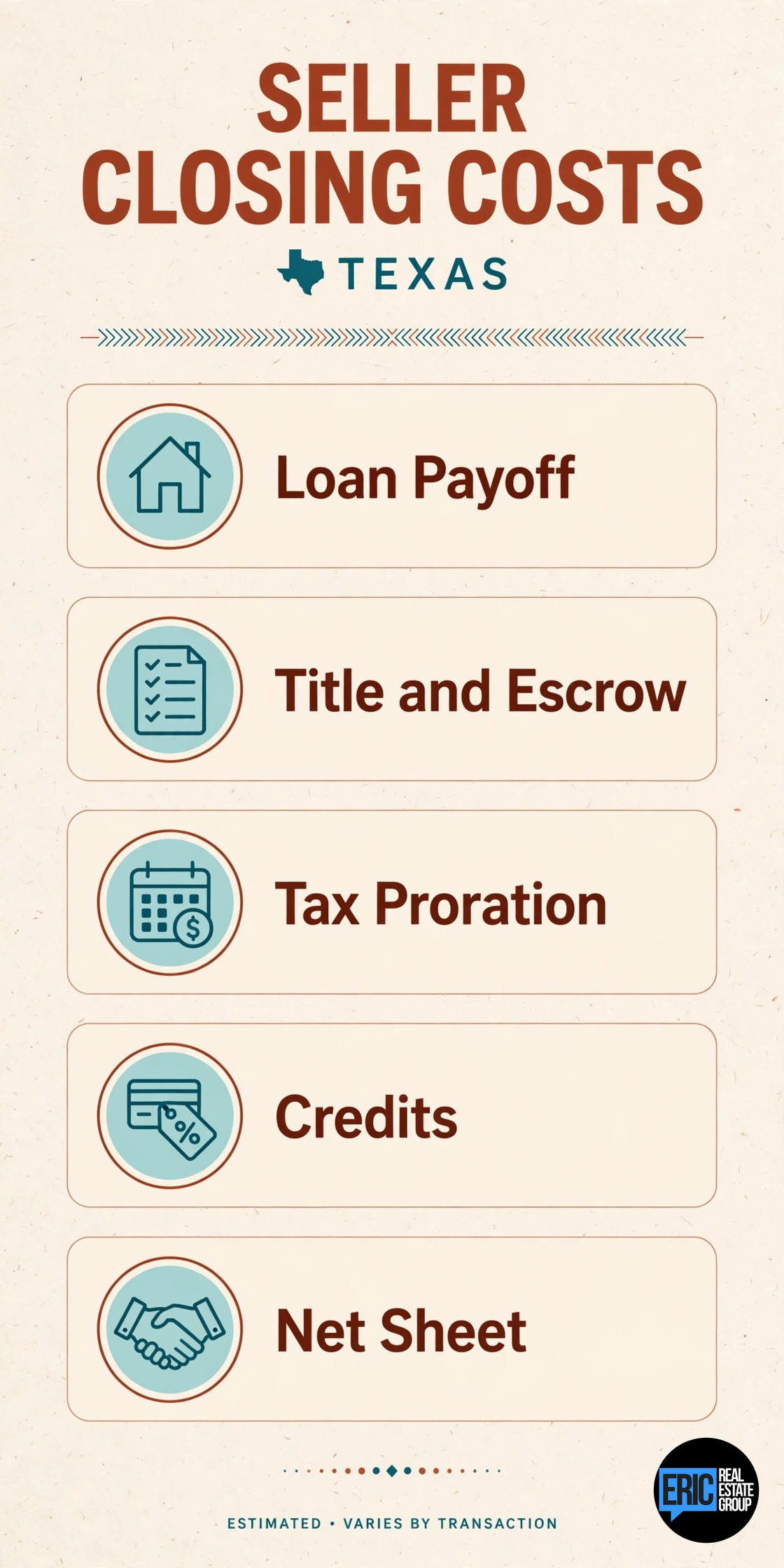
What sellers pay at closing in Texas is not a mystery once you see the categories. Loan payoff, title and escrow charges, tax prorations, negotiated credits, and the smaller file charges. The exact total depends on your payoff, your contract, and your closing date.
If you are thinking about selling in McAllen, Edinburg, Mission, Pharr, Weslaco, or San Juan, call me before you list. I will run the numbers with you, explain every line in plain English, and help you judge offers by what you actually keep.
Looking to buy or sell in the Rio Grande Valley?
Eric Jimenez | Eric Real Estate Group, LLC | 956-292-4500 | eric@bettercalleric.com | bettercalleric.com
Better Call Eric. Listings that sell.