


Hey, it's Eric.
If you are trying to sell my house McAllen style, meaning fast, clean, and for a fair price, a low offer can feel personal. You know what you paid, what you fixed, and what your home is worth to you. The buyer sees a number on a screen and takes a shot. Learning how to handle low offers without losing the buyer is one of the most important skills a seller can have in the Rio Grande Valley, because a low first offer is often not a final offer. It is a starting point.
I see this in McAllen, Edinburg, Mission, Pharr, Weslaco, and San Juan all the time. A buyer comes in well under asking, and the seller wants to reject it on the spot. In my experience, sellers who pause, run the numbers, and counter with a plan often end up closing with that same buyer at a price they can live with.
How to handle low offers starts with checking your price
Before you blame the buyer, take an honest look at your list price. If your home has been sitting with showings but no offers, the market may be telling you something. A low offer on a well priced home is different from a low offer on a home that started high.
That is why I go back to the basics in How to Price Your RGV Home Right: What the Data Says . Look at recent comparable sales near you, not just active listings. If your price is supported, you can counter with confidence. If it is not, a low offer may be your first real piece of market feedback.
Do not reject, counter
A flat rejection ends the conversation. A counter keeps it alive and puts the ball back in the buyer court. Even if you counter close to your asking price, you are telling the buyer you are willing to work toward a deal.
A good counter does more than change the price. Look at the full offer:
- Price and how far it is from your bottom line
- Earnest money and option money, and whether they show the buyer is serious
- Financing type and whether the buyer is pre approved
- Closing date and whether it fits your move
- Requests for repairs, credits, or personal property
- Contingencies that could slow the deal or kill it later
Sometimes a slightly lower price with clean terms and a fast closing is worth more than a higher price with shaky financing. Judge the net and the certainty, not just the headline number.
Find out why the offer came in low
Ask the buyer agent, in a professional way, what drove the number. Sometimes it is not about your home at all.
In my experience the reason is often one of these:
- The buyer is testing the market and expects a counter
- The buyer is working with a tight monthly payment and needs help on terms
- The buyer saw a repair or an older roof or AC system and priced in that worry
- The buyer agent used older or weaker comparable sales
Once you know the reason, you can answer the real problem. If payment is the issue, a small credit may help more than arguing about price alone. I explained that tradeoff in Seller Concessions in the RGV: When Credits Beat Price Cuts .
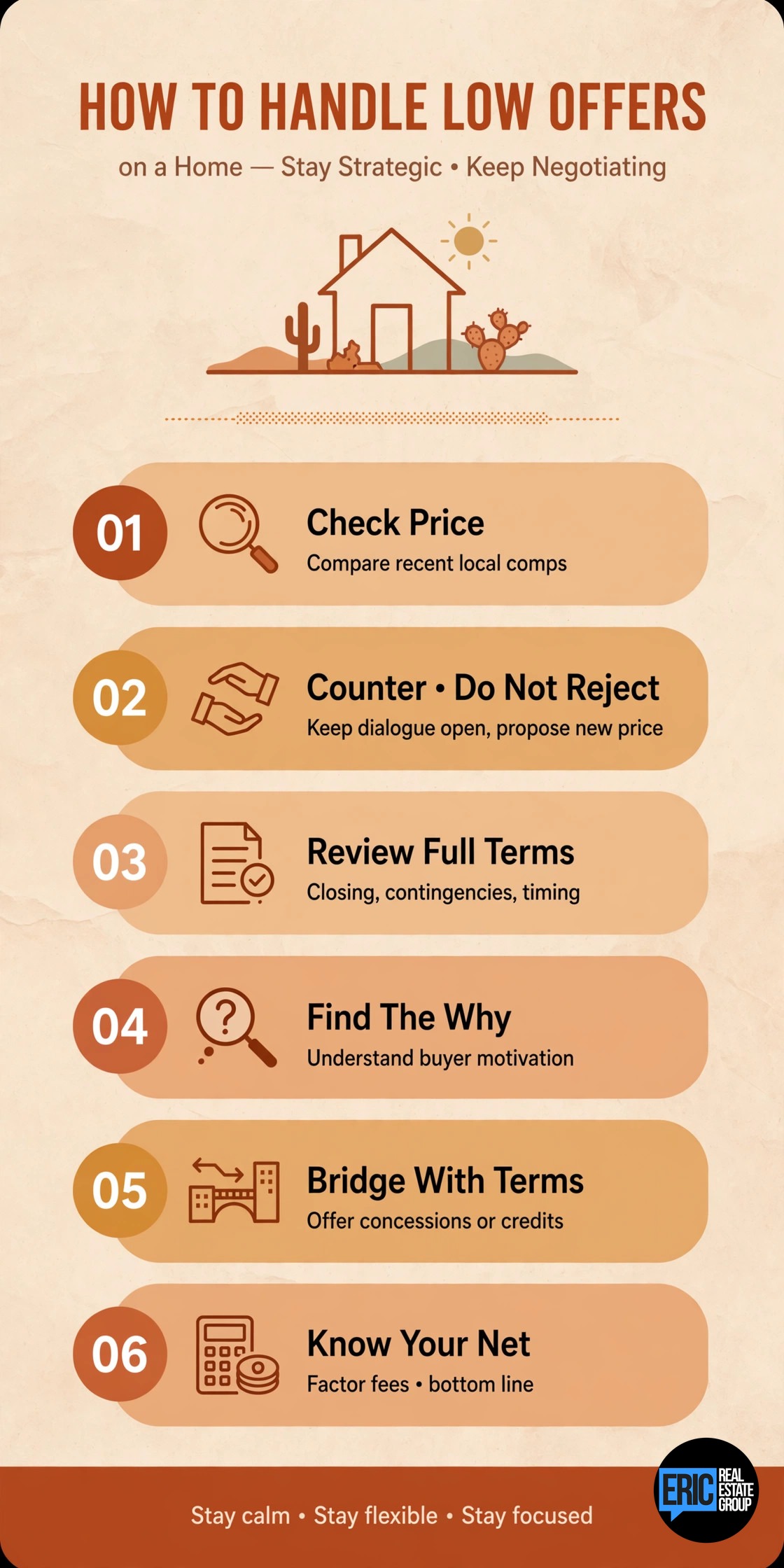
Use terms to bridge a price gap
Price is only one lever. When you are apart, look for other ways to make the deal work.
Ideas that can help in the right situation:
- Meet partway on price and ask for stronger earnest money in return
- Offer a closing cost credit instead of a deeper price cut, if the numbers work for your net
- Adjust the closing date to help the buyer with a lease ending or a rate timeline, if it does not hurt your move
- Include or exclude specific personal property items that the buyer values
- Ask for proof of funds for any cash portion and a current pre approval letter
Use a seller net sheet for every version. Start with price, subtract your loan payoff, title and escrow charges, tax prorations, and any credits. That bottom line tells you whether a counter is worth signing. As a hypothetical example, a buyer who offers less but can close quickly with strong earnest money may give you a better net and less stress than a higher offer that drags out and asks for repairs at every step.
Stay calm and keep emotion out of the reply
Your home holds memories. The buyer does not see those memories in the price. Try not to read a low offer as disrespect. Buyers are told to negotiate, and many are nervous about making a mistake.
Keep communication through your agent, keep it written, and keep it focused on facts, comparable sales, condition, and the terms you need. Emotion makes sellers reject deals they would have accepted a day later. A calm counter with a short deadline also signals you are serious.
Local context matters too. In my guide on Selling a Home in Edinburg TX: Local Tips That Matter I talk about how local demand shapes what buyers will pay. The same thinking applies in McAllen, Mission, and Pharr. Know your street, not just your city.
When to walk away from a low offer
Countering is smart, but it does not mean you accept anything. Walk away, politely, when the buyer will not move in any meaningful way after a fair counter, when financing looks weak with no proof to support it, or when the terms put you at risk with no benefit in return.
Walking away works best when you have a plan B. Keep showings going and keep the home ready while you negotiate. If this buyer is the only interest after a long time on market, that is also information. Talk with me about whether a price adjustment, a repair, or fresh marketing will bring in stronger buyers.
The bottom line on low offers in the Valley
How to handle low offers comes down to this. Check your price against real sales, do not reject out of emotion, counter with a full look at price and terms, find out why the buyer started low, and use credits and timing to bridge the gap when it helps your net. Some low offers will never become deals. Many will, if you keep the conversation alive long enough to find the middle ground.
If you got an offer that feels too low and you do not know whether to counter or walk away, call me before you answer. I will run the comparable sales and the net sheet with you, and we will respond with a plan, not a reaction.
Looking to buy or sell in the Rio Grande Valley?
Eric Jimenez | Eric Real Estate Group, LLC | 956-292-4500 | eric@bettercalleric.com | bettercalleric.com
Better Call Eric. Listings that sell.