


Multiple Offers as a Seller in the Valley: Picking the Strongest Contract, Not Just the Highest Price
Hey, it's Eric.
If you are thinking sell my house McAllen and you get more than one offer, congratulations, but do not stop at the highest number. In McAllen, Edinburg, Mission, Pharr, Weslaco, and San Juan, I have seen the highest price lose to a cleaner contract once financing, appraisal, and deadlines are counted. The strongest offer is the one most likely to close, on time, for the money you actually keep.
I am a realtor McAllen TX, and this is the checklist I walk through with sellers before anyone signs. Price matters. It just does not matter alone.
Multiple offers in Texas: how to sell your house fast without picking the wrong buyer
Start with the full picture for every offer, side by side. Do not compare only price in a text message or on a scrap of paper. Put each offer on one sheet with the same fields, so a strong term in one column does not hide a weak term in another.
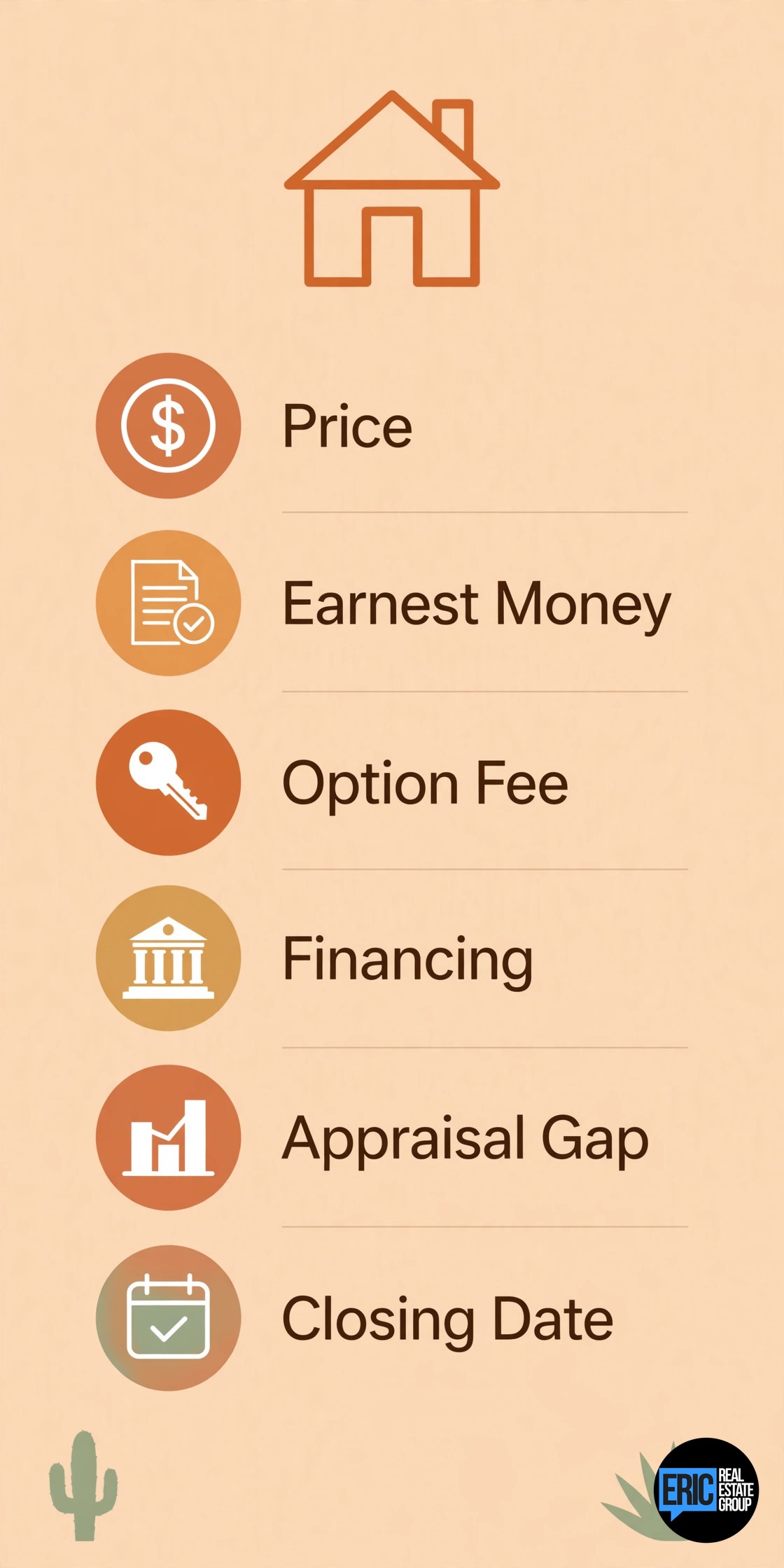
My comparison checklist for every offer:
- Contract price, and what the buyer is really offering after any seller credits or concessions they ask for
- Earnest money amount and percent of price, and where it will be held, usually the title company named in the contract
- Option fee amount and option period length in days, because a long option period gives the buyer more time to walk away
- Financing type: cash, conventional, FHA, VA, or other, plus whether a pre approval letter from a lender is attached, not just a pre qualification
- Down payment amount or percent, which tells you how much cash the buyer brings if the appraisal is tight
- Appraisal gap language: will the buyer cover a shortfall in cash, up to what dollar cap, or is there no gap coverage at all
- Closing timeline, title company, and any contingencies, like needing to sell another home first
- Personal property, leaseback, or special provisions that change the real value or your move out date
That list is the same discipline I use when an offer comes in low, which I cover in How to Handle Low Offers Without Losing the Buyer. Whether the number is low or high, the terms decide whether it closes.
Earnest money, option fee, and financing type tell you how serious the buyer is
Earnest money is the buyer's deposit held in escrow. In my experience, a buyer who puts down a larger earnest amount, for example around 1 percent of price or more on a Valley priced home, is signaling more commitment than a buyer who puts down a very small amount, because that money is at risk after the option period under the contract terms. Read the exact contract language with your agent. Do not assume.
The option fee pays for the buyer's unrestricted right to terminate during the option period. A higher option fee with a shorter option period is usually cleaner for a seller than a tiny option fee with a long option period. The fee itself is small money. The signal and the timeline are what matter.
Financing type matters just as much. Cash removes the lender and the appraisal ordered by a lender, but you still verify proof of funds. Conventional financing with a strong down payment is often cleaner than a loan with a very small down payment if the appraisal is a concern. FHA and VA loans are good loans that help a lot of Valley buyers, and they can bring lender required condition repairs, so factor in the condition of your roof, AC, and safety items. None of this is a reason to reject a buyer out of hand. It is a reason to price the risk honestly.
Ask for the lender letter, call the lender if the buyer authorizes it, and confirm the buyer has been reviewed for income, assets, and credit, not just given a quick online letter.
Appraisal gap language: where a high price can disappear
If a buyer offers above what the home will appraise for, the lender will base the loan on the appraised value, not the contract price. The difference is the appraisal gap. Unless the contract says the buyer will bring extra cash to cover some or all of that gap, up to a stated cap, the high price can fall apart at appraisal.
Look for clear language: buyer will pay up to a specific dollar amount above appraised value, not to exceed the contract price, or buyer will not cover a gap and price will adjust. Vague promises in a text do not count. Only what is written in the signed contract and any addendum counts.
This is why pricing right from the start still matters, even in a multiple offer week, which I explain in How to Price Your RGV Home Right: What the Data Says. A price the comps can support is a price an appraiser can support.
A two offer worked example, hypothetical numbers only
Here is a hypothetical example, with made up numbers for illustration only, on a Valley home listed in McAllen. It is not a real sale and not a promise of value.
Offer A: Price $285,000. Financing: FHA with a small down payment. Earnest money $500, which is well under 1 percent. Option fee $100 with a 10 day option period. No appraisal gap coverage written in. Buyer asks for a seller credit toward closing costs. No lender pre approval letter attached, only a pre qualification.
Offer B: Price $278,000. Financing: conventional with a larger down payment. Earnest money $2,780, which is about 1 percent of price. Option fee $500 with a 7 day option period. Appraisal gap language says buyer will bring up to $10,000 in extra cash above appraised value, not to exceed the contract price. No seller credit asked for. Strong lender pre approval letter attached.
On price alone, Offer A wins by $7,000. On closing risk, Offer B is stronger on almost every line on the checklist: more earnest money at risk, a shorter option period, more buyer cash for a gap, no credit back to the buyer, and a lender who has already reviewed the file. In my experience, many sellers in this spot pick Offer B, or counter Offer A to match the stronger terms, because a contract that closes at $278,000 beats a contract that fails at $285,000.
You can also counter for better terms instead of just accepting one offer as written. Ask the weaker offer to raise earnest money, shorten the option period, add a gap cap in writing, or attach a real pre approval. How they respond tells you a lot.
And keep a backup position in mind. If the first contract fails, a signed backup offer can save weeks, which I walk through in Backup Offers and Option Periods: A Texas Seller Playbook.
How to pick and respond without creating a mess
Tell every buyer agent the same deadline and the same process. Ask for highest and best by a clear date and time if your agent recommends it, and keep notes of what was received and when. Do not make promises to one buyer while you are still reviewing another.
Review the net, not just the price. Subtract seller credits, estimate your closing costs, and look at your move timeline. A slightly lower price with a closing date that matches your next home, or a short leaseback if you need it and it is written correctly, can be worth real money and real stress saved.
Finally, get the winning terms in the signed contract exactly as discussed. Earnest money, option fee, gap cap, deadlines, and contingencies must match the sheet you compared. If it is not in writing, it is not in the deal.
Multiple offers are a good problem to have in the Rio Grande Valley. Handle them with a checklist, verify the lender and the cash, and pick the contract most likely to get you to the closing table.
Looking to buy or sell in the Rio Grande Valley?
Eric Jimenez | Eric Real Estate Group, LLC | 956-292-4500 | eric@bettercalleric.com | bettercalleric.com
Better Call Eric. Listings that sell.
Start Your Search: Rio Grande Valley Homes for Sale
Reading about the market is smart. Looking at real homes is better. Try one of these searches, then create a free account to save your favorites and get new listings emailed to you the moment they hit the market.
- Homes for sale in McAllen
- Homes for sale in Edinburg
- Search all Rio Grande Valley homes
- Find out what your home is worth
See a home you like? Call Eric Jimenez at 956-292-4500 and I will set up a showing.