


Price Reductions in the RGV: When to Cut, How Much, and What the Data Triggers
Hey, it's Eric.
If you are thinking sell my house McAllen and your home has been sitting while other houses are getting showings, a price reduction is probably on your mind. I am a realtor in McAllen TX, and I know that conversation is not fun. Nobody wants to cut. But in my experience, waiting too long at a price buyers are not responding to costs more than cutting early and clean. The goal is not to give your home away. The goal is to read what the market is telling you, make one smart move, and get back in front of the right buyers.
What a price reduction really does when you want to sell my house McAllen
A price cut is not just a lower number. It is a new signal to buyers, to their agents, and to the search sites.
When you reduce, your listing can show up as price reduced, it can trigger alerts to buyers who saved your home or who are watching your area, and it can put you into a whole new set of search results. That last part is the one sellers miss most.
Buyers search in brackets. They set a max price and they never see homes above it. If you are just above a round number bracket, you are invisible to a big group of buyers even if you are close. A cut that crosses that bracket is very different from a tiny cut that stays in the same bracket.
That is why I always start with strategy, not panic. I lay out that first pricing decision in How to Price Your RGV Home Right: What the Data Says. A reduction works best when it fixes the original problem, not when it just chases the market down in small steps.
The showing and days on market thresholds I watch
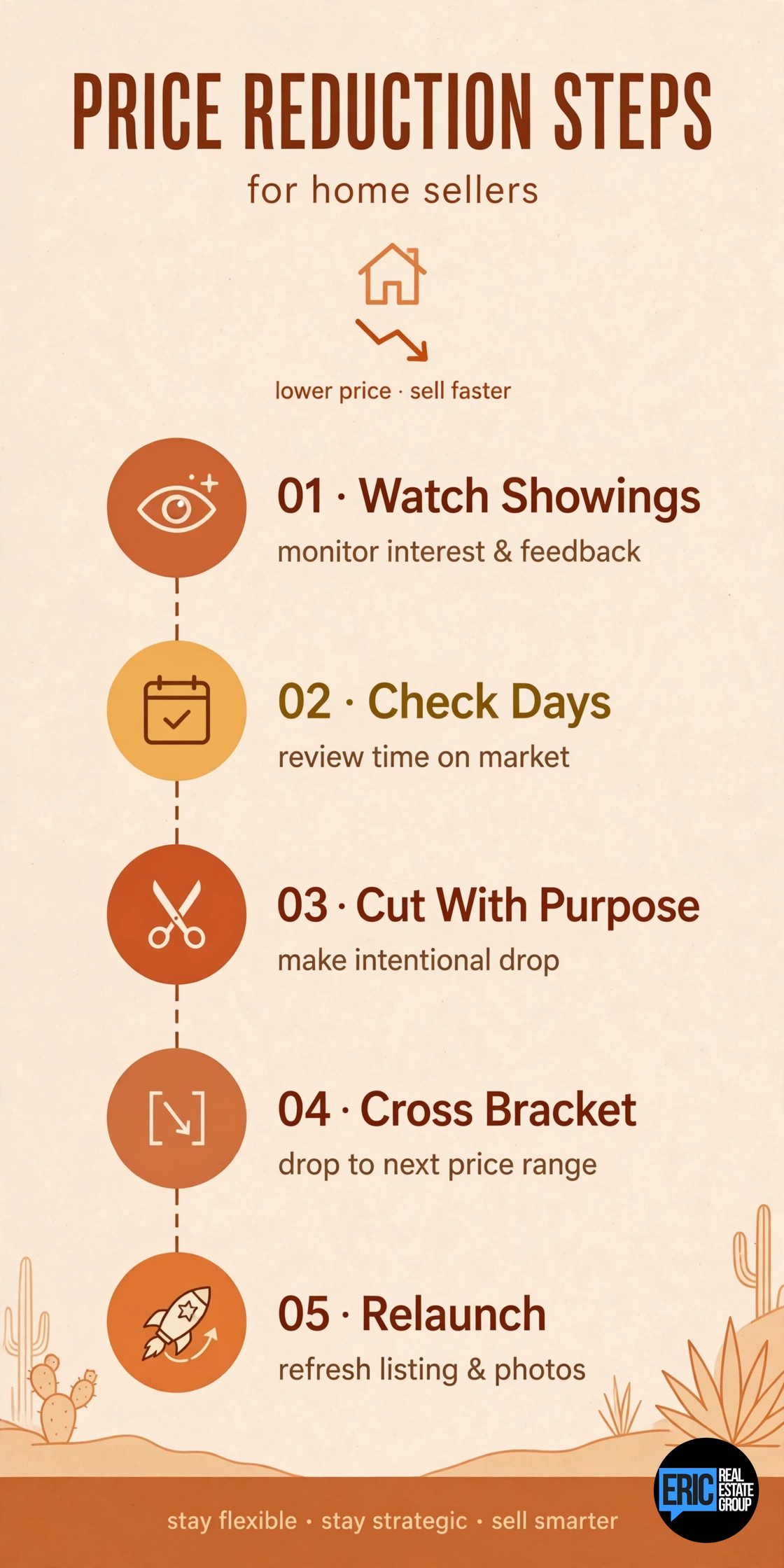
I do not use one magic day count for every house in McAllen, Edinburg, Mission, Pharr, Weslaco, and San Juan. Price range, condition, and competition matter. But in my experience, these thresholds should trigger a serious talk about a cut:
- No showings in the first 7 to 10 days: something is off. Check photos, access, and condition first, but price is the most common reason buyers skip a home completely.
- Showings but no offers after 10 to 14 days: buyers like the area or layout enough to look, but they are choosing other homes on value.
- Plenty of online views and saves but few showing requests: buyers are considering you and then passing. They are comparing you to nearby competition and your price is not winning.
- 21 days on market with no second showings and no real offer talk: in my experience, this is a clear stale signal. Waiting for one perfect buyer rarely fixes it.
- 30 days on market: buyers and agents start to assume something is wrong or that you will take much less. A planned cut before this point usually puts you in a stronger spot than a desperate cut after it.
If feedback says the home shows well but needs one repair, price may not be the only lever. Sometimes a credit or a fix is smarter. I talk through that choice in Seller Concessions in the RGV: When Credits Beat Price Cuts. But if feedback keeps coming back as price, believe the feedback.
How much to cut, and why small cuts often fail
A tiny cut rarely changes buyer behavior. In my experience, a cut needs to do at least one of these jobs:
- Move you into the next search bracket buyers are actually using
- Make you clearly better value than the closest competing home
- Create a real reason for buyers who already saw you to look again
If a cut does none of those, you gave up money and got no new attention. I would rather see one meaningful cut at the right time than three small cuts spread over a month. Each small cut trains buyers to wait for the next one.
Before you decide the amount, look again at recent sold homes, pending homes, and your direct active competition today, not just the day you listed. New listings under you change your position even if you do nothing.
I explain how that pressure builds in Why Some RGV Listings Go Stale (and How to Fix Yours). A stale listing is not fixed by time. It is fixed by a change buyers can see.
A worked example, $315,000 to $299,900
Here is a hypothetical example. Say a home in McAllen is listed at $315,000. It gets views, a few showings in week one, then traffic slows. Feedback says buyers like the home but think it is high compared to two nearby homes.
Cutting to $310,000 is a $5,000 move. It helps a little, but the home is still above $300,000, so it still does not appear for buyers who set their search max at $300,000.
Cutting to $299,900 is a $15,100 move, about 4.8 percent. That is a bigger decision, and it should only be made if the comps support it. But look at what changes:
- The home now appears in searches capped at $300,000, a bracket it missed before
- It shows as a price reduced listing to buyers watching the area
- Saved search alerts can go out again with the new price
- It now reads as under $300,000 instead of over $300,000, which changes how buyers talk about it
That does not guarantee an offer. No cut does. It does guarantee you are now competing in a different and larger buyer pool, instead of asking the same pool to change its mind for $5,000.
If the comps do not support $299,900, do not force that number just to chase a bracket. The right cut is the highest price that is still honest to recent sales and to your current competition.
What to fix before or with the cut
Do not cut price to hide a fixable problem. Before the new price goes live, check:
- Are the first photos bright, current, and in the right order?
- Is showing access easy, with quick confirmations?
- Is the home clean, cool, and light when buyers walk in, which matters a lot in Valley heat?
- Did feedback name one repair again and again, like AC, roof, paint, or flooring? Price that repair honestly or fix it if you can.
- Does the listing copy name the real strengths, schools, commute, lot, updates, and outdoor space?
A cut plus fresh photos or a small fix can relaunch a listing. A cut alone, with the same photos and the same showing problems, often gets the same result at a lower price.
How to sell your house fast in Texas after a reduction
Once you cut, treat the next 7 days like a new launch. Tell every agent who showed the home. Watch the same signals again: views, saves, showing requests, second showings, and offer talk.
If the new price brings showings but still no offers, the problem may be terms, condition, or a specific objection you can solve with a credit, a closing timeline, or a repair. If it brings no new showings at all, you need a harder look at price and competition, not more waiting.
The best time to sell a house in Texas is when buyers can see value the first time they find you. A smart reduction is not failure. It is you responding to real data before your days on market start working against you.
If your RGV home is sitting and you are not sure whether to cut, how much, or whether to fix something first, call me. We will look at your showings, your feedback, your days on market, and your closest competition together, and we will pick a number you can defend.
Looking to buy or sell in the Rio Grande Valley?
Eric Jimenez | Eric Real Estate Group, LLC | 956-292-4500 | eric@bettercalleric.com | bettercalleric.com
Better Call Eric. Listings that sell.
Start Your Search: Rio Grande Valley Homes for Sale
Reading about the market is smart. Looking at real homes is better. Try one of these searches, then create a free account to save your favorites and get new listings emailed to you the moment they hit the market.
- Homes for sale in McAllen
- Homes for sale in Edinburg
- Search all Rio Grande Valley homes
- Find out what your home is worth
See a home you like? Call Eric Jimenez at 956-292-4500 and I will set up a showing.