


Seller Financing in Texas: How It Works, What Protects You, and When to Say No
Hey, it's Eric.
If you are thinking about seller financing in Texas while you try to sell my house McAllen, you are not alone. Sellers in McAllen, Edinburg, Mission, Pharr, Weslaco, and San Juan ask me about it when a buyer cannot quite qualify with a bank, or when they own their home free and clear and like monthly income instead of one lump sum. I am a realtor in McAllen TX, not a lawyer or tax advisor. I will explain how it is usually structured, what paperwork protects you, and when to say no.
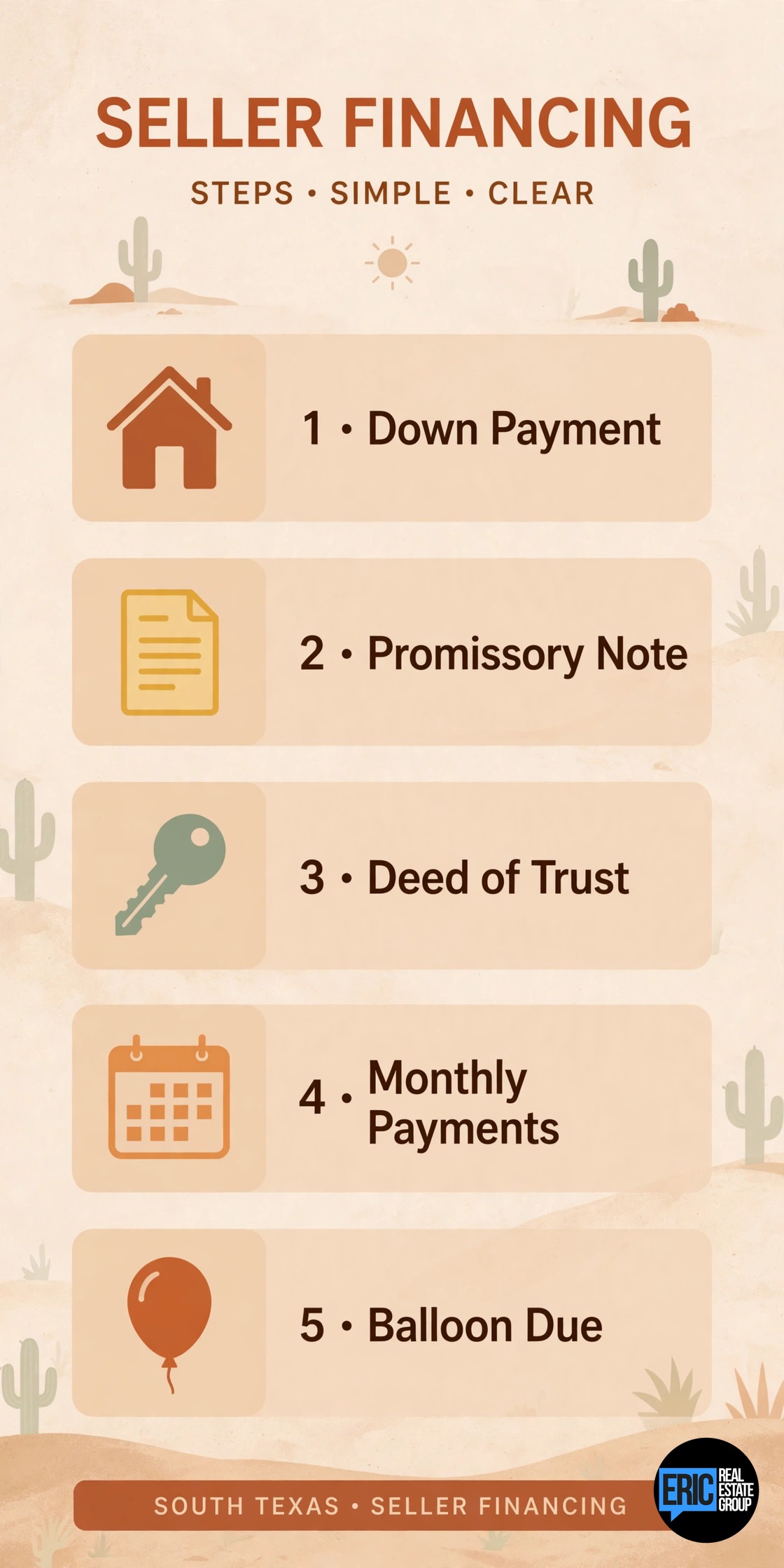
How seller financing in Texas works, step by step
In a normal sale, a bank pays you at closing and you are done. In seller financing, you step into the lender role. The buyer puts money down, moves in, and pays you monthly with interest until the balance is paid or refinanced.
That can open your home to more buyers and create steady income. It also ties your money to that house and buyer for years. If the buyer stops paying, you are the bank, and getting the home back takes a legal process.
Before you price any deal, get your market value straight. I explain that in How to Price Your RGV Home Right: What the Data Says. A seller financed price is still a price, and it should start with real comparable sales.
The promissory note and deed of trust structure that protects you
A handshake is not enough. In my experience, a properly built Texas seller financed sale uses several documents together, prepared and reviewed by a real estate attorney and a title company.
- The sales contract sets the price, down payment, interest rate, payment, term, and who pays taxes, insurance, and closing costs, and states clearly that this is seller financing.
- The promissory note is the buyer promise to pay in writing. It spells out the loan amount, rate, payment, due date, late fees if any, and what happens on default. If it is not in the note, do not count on it.
- The deed of trust ties the loan to the property, is recorded in the county records, names a trustee, and gives a path to foreclosure if the buyer does not pay. Without a recorded deed of trust, your protection is much weaker.
- The deed to the buyer transfers title at closing in a typical Texas seller financed closing, with the deed of trust securing your position as lender. This is different from a contract for deed, which carries different rules and risks.
- Taxes and insurance proof should be required in writing, because a tax lien or a lapsed policy puts your collateral at risk.
Get your normal closing costs clear too. I break those down in What Sellers Pay at Closing in Texas: A Clear Breakdown. Texas has specific seller financing rules, so use a Texas real estate attorney on your specific deal, not just a form from the internet.
Typical down payment, rate, and term ranges sellers talk about
Every deal is negotiable. The numbers below are examples of ranges I commonly see discussed, not promises or a quote for your home.
- Down payment: often 10 percent to 20 percent or more of the price. On a hypothetical 250,000 dollar home, that would be 25,000 dollars to 50,000 dollars down. A larger down payment means the buyer has more to lose and you have a bigger cushion if values dip or repairs are needed.
- Interest rate: often higher than a bank rate, because the buyer pays for flexibility and you take added risk. The rate must be in the note and comply with Texas law.
- Term and balloon: many notes use payments based on a longer schedule, with a balloon payment due in 3 years to 10 years, when the full remaining balance comes due and the buyer is expected to refinance or sell.
- Payment: never rely on a verbal number. Your attorney and title company will calculate the exact payment from the rate and schedule, and you should read it in the note before you sign.
Compare that long timeline to a clean listed sale or a discounted cash sale. I put that comparison in plain dollars in Selling to an Investor vs Listing in the Valley: The Cash Offer Math, Side by Side.
The due on sale warning if you still have a mortgage
This is the warning I give first. If you still owe on your home, your loan almost certainly has a due on sale clause, which generally lets your lender demand the full balance if you transfer the home without lender permission.
Seller financing a home you have not paid off can trigger your own loan coming due, even if the buyer pays you on time. Do not hide a transfer from your lender. Talk to your lender and attorney first. In my experience, seller financing is cleanest when you own the home free and clear.
Other risks are plain. The buyer could stop paying, damage the home, let insurance lapse, or fall behind on taxes. Foreclosure takes time and legal cost. You also need a servicing plan for collecting payments, keeping records, and reporting interest for taxes. Many sellers hire a loan servicing company.
When to say no to seller financing
Say no, or at least pause, when:
- You still have a mortgage and you have not cleared the due on sale issue in writing
- The buyer offers a very small down payment and cannot show income, reserves, or a payment history you can verify
- The buyer pushes you to skip the title company, skip the attorney, or use only a simple contract with no recorded deed of trust
- You need your equity out now for your next home, medical needs, or a family obligation
- The term is so long that you would still be collecting payments well into a stage of life when you do not want that responsibility
- You have not checked what is my McAllen home worth on the open market first, so you do not know what you are giving up
The best time to sell a house in Texas is when the structure fits your life, not just when a buyer asks for terms. If you want to know how to sell your house fast in Texas without years of lender risk, listing to the full market or getting competing cash offers may fit better.
If seller financing still looks right, do it fully protected, with verified down payment funds, a written promissory note, a recorded deed of trust, insurance and tax requirements in writing, a servicing plan, and an attorney review before you sign.
Looking to buy or sell in the Rio Grande Valley?
Eric Jimenez | Eric Real Estate Group, LLC | 956-292-4500 | eric@bettercalleric.com | bettercalleric.com
Better Call Eric. Listings that sell.
Start Your Search: Rio Grande Valley Homes for Sale
Reading about the market is smart. Looking at real homes is better. Try one of these searches, then create a free account to save your favorites and get new listings emailed to you the moment they hit the market.
- Homes for sale in McAllen
- Homes for sale in Edinburg
- Search all Rio Grande Valley homes
- Find out what your home is worth
See a home you like? Call Eric Jimenez at 956-292-4500 and I will set up a showing.