



Selling a Condo in the RGV: HOA Docs, Resale Certificates, and Buyer Financing Hurdles
Hey, it's Eric.
If you are thinking sell my house McAllen, but the home is actually a condo, your sale runs on different rules than a single family house in McAllen, Edinburg, Mission, Pharr, Weslaco, or San Juan. You are selling your unit inside a project that has a budget, insurance, rules, and reserves that a buyer and a lender will read line by line. In my experience, condo deals in the Valley rarely fall apart over the kitchen. They fall apart over documents and financing, usually late.
I am a realtor McAllen TX, and my job on a condo listing is to get the paperwork moving before we go under contract, while you still have time to price honestly and talk to cash and strong loan buyers with your eyes open.
Why selling a condo in the RGV is not the same as selling a house
With a house, the lender mostly underwrites the buyer, the home, and the title. With a condo, the lender also underwrites the whole project. If the association is behind on money or paperwork, a buyer can love your unit and still not be able to borrow to buy it.
So the questions start earlier. What are the monthly dues, and what do they cover. Is a special assessment coming. Are there rental restrictions. Is parking assigned. Buyers often start with my guide on Buying a Condo vs a House in the Valley: Costs and Lifestyle Compared, and sellers should read it too, because it shows the questions your buyer is already asking.
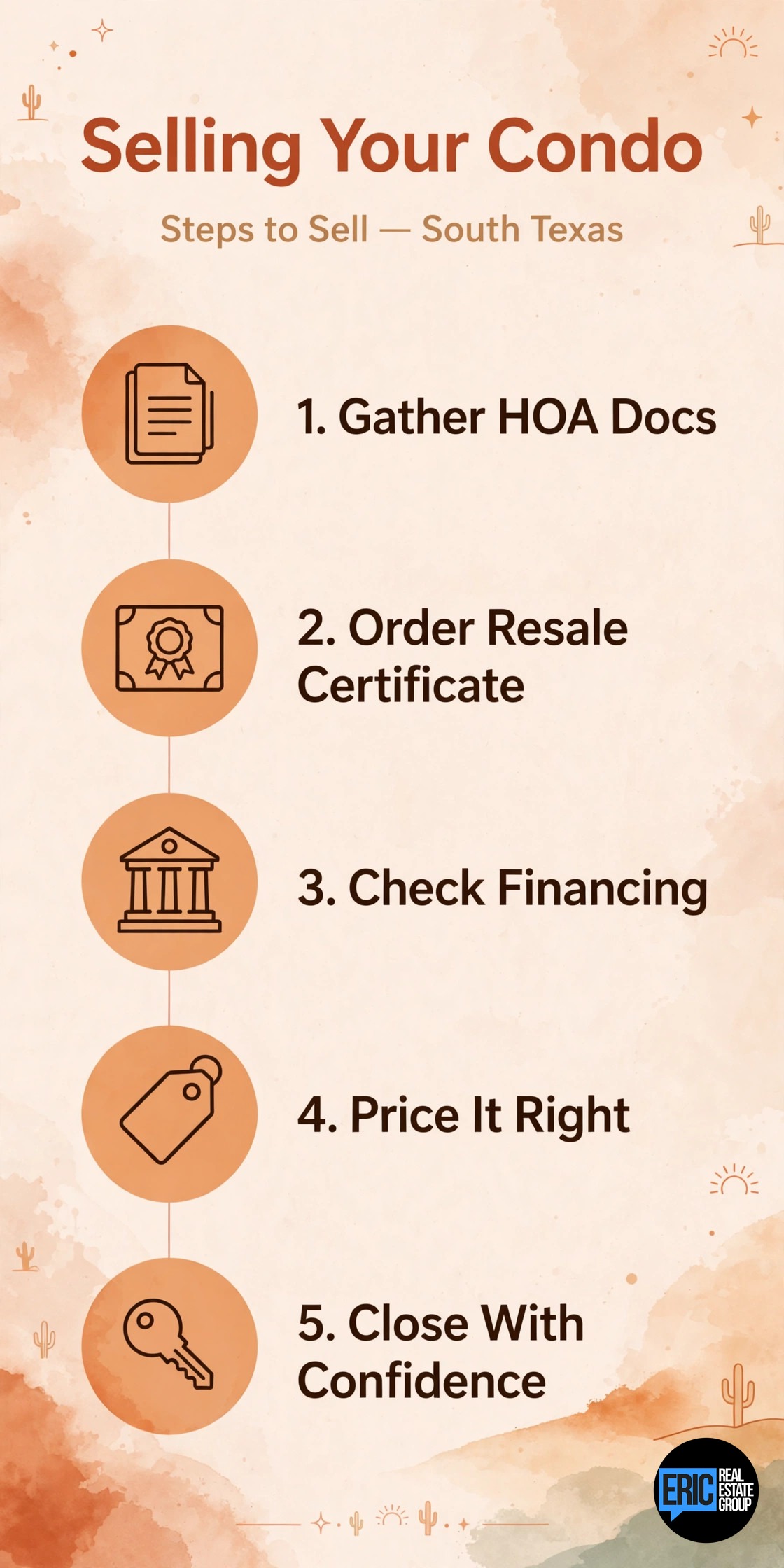
The HOA docs a condo seller should gather before listing
Do not wait for a contract to start chasing documents. In my experience, the sellers who gather this packet in week one close smoother than the sellers who order everything after the option period starts.
Have these ready, or know exactly how to order them:
- The declaration, bylaws, and any association rules a buyer is entitled to receive
- The current operating budget and balance sheet for the association
- A summary of the association insurance coverage
- Your current dues amount, what the dues cover, and whether you are current
- Any approved or discussed special assessments, and what they will pay for
- Rental rules, parking assignments, pet rules, and any age or occupancy restrictions in the project
- Any known litigation, code notices, or major repair plans that the association has disclosed
Some of this overlaps with a regular subdivision sale, and I cover the broader dues and rules picture in HOA vs No HOA in the RGV: Fees, Rules, and Resale Impact. A condo goes further, because the association documents become part of the buyer financing file, not just reading material for the buyer.
The resale certificate: cost and delivery deadline under Texas law
Here is the part with real numbers, and they come straight from Texas law. Under Texas Property Code Section 82.157, before a unit owner sells, the owner must furnish the purchaser a current copy of the declaration, bylaws, any association rules, and a resale certificate prepared not earlier than three months before it is delivered to the purchaser.
The association must furnish that resale certificate not later than the 10th day after it receives a written request from the unit owner. That is 10 calendar days under the condo statute, not 10 business days. Order it late and you have built a delay into your own closing.
The association may charge a reasonable and necessary fee to furnish the resale certificate, and under Section 82.157 that fee may not exceed $375. If someone quotes you more than $375 for the certificate itself, ask them to show you the breakdown in writing. Separate transfer fees or other association fees can exist, and the certificate is supposed to list all fees payable to the association or its agent that are tied to the transfer of ownership, with a description, who is paid, and the amount. Read that list before closing, not at the closing table.
The certificate itself is not a formality. It states items like any right of first refusal, your periodic common expense assessment, unpaid common expenses or special assessments due from you, other unpaid amounts you owe the association, capital expenditures approved for the next 12 months, and the association current operating budget and balance sheet. If the association does not furnish the certificate within that 10 day period, Texas law lets the unit owner provide the purchaser with a sworn affidavit in lieu of the certificate. That is a backup, not a plan. A lender may still want the real document.
Practical tip from my side of the desk: order the certificate as soon as you decide to sell, confirm the request in writing, and calendar day 10. Do not assume the management company started the clock just because someone mentioned it on a phone call.
The warrantability issue that kills condo loans
This is the hurdle most condo sellers have never heard of until it stops their sale. Lenders and loan investors review condo projects for eligibility, often called warrantability. A project can be turned down for reasons that have nothing to do with your buyer credit or your unit condition.
In plain English, a project review can look at things like:
- Whether the association budget puts enough into reserves
- Whether too many owners are behind on their dues
- Whether one person or company owns too many units in the project
- Whether too much of the project is rented out or used as commercial space
- Whether there is pending litigation involving the association
- Whether the association insurance is adequate and current
- Whether a special assessment signals a big unfunded repair problem
If the project fails that review, a conventional loan can be denied even with a strong buyer. Some buyers may be able to look at other loan paths, a larger down payment, or a lender that keeps loans in house, but none of that is guaranteed, and FHA and VA buyers face their own project approval questions. Cash buyers skip the lender review entirely, which is why condo sellers sometimes get very interested in a slightly lower cash offer after a financing deal has already failed once. I am not telling you to take less. I am telling you to weigh certainty honestly, the same way I walk through seller costs in What Sellers Pay at Closing in Texas: A Clear Breakdown.
You cannot fix the whole association before you list. What you can do is ask the hard questions early, get the budget and insurance facts in writing, and price and market the condo to the buyer pool that can actually close on it. Asking what is my McAllen home worth on a condo has to include the financing reality, not just square footage and recent sales.
How to sell your condo faster in McAllen and the Valley
A clean condo sale is mostly preparation. Bring your dues current and keep every association letter. Order the resale certificate before the first showing if you can. Be upfront about any special assessment, rental cap, or big roof project, because a buyer who learns it early can plan, and a buyer who learns it in week three feels surprised. Ask which lenders have closed in your project recently. That one question can save you a month. And read every offer for financing strength, not just price.
Valley condos appeal to downsizers, Winter Texans, first time buyers who want lower exterior maintenance, and investors where the rules allow renting. The sellers who do best hand a buyer and a lender a complete, honest file from day one.
Looking to buy or sell in the Rio Grande Valley?
Eric Jimenez | Eric Real Estate Group, LLC | 956-292-4500 | eric@bettercalleric.com | bettercalleric.com
Better Call Eric. Listings that sell.
Start Your Search: Rio Grande Valley Homes for Sale
Reading about the market is smart. Looking at real homes is better. Try one of these searches, then create a free account to save your favorites and get new listings emailed to you the moment they hit the market.
- Homes for sale in McAllen
- Homes for sale in Mission
- Search all Rio Grande Valley homes
- Find out what your home is worth
See a home you like? Call Eric Jimenez at 956-292-4500 and I will set up a showing.