


Wholesale and Assignment Offers in Texas: What RGV Sellers Are Really Signing
Hey, it's Eric.
If you are thinking sell my house McAllen and someone offers to buy it fast, with no repairs and no showings, read the contract twice before you sign. Some of those buyers plan to live in the home or rent it. Others plan to assign the contract to a different buyer for a fee, and you may not meet the real buyer until closing week, if that buyer shows up at all. That is wholesaling, and in the Rio Grande Valley I see sellers in McAllen, Edinburg, Mission, Pharr, Weslaco, and San Juan sign these offers without spotting the assignment language.
I am a realtor McAllen TX, and I am not here to tell you every investor offer is bad. I am here to show you the exact wording, money, and timeline tells that separate a real buyer from a contract flip, so you can decide with your eyes open.
Wholesale offers in Texas: how to sell your house fast without signing away control
A wholesale offer usually works like this. A person signs a contract to buy your home at one price. Before closing, that person assigns, or transfers, their right to buy to another buyer, often an investor, for an assignment fee. The second buyer closes, if they close. Your price does not go up because the assignment fee was added on top. The first signer may never have planned, or been able, to close with their own money.
Assignment is not automatically illegal in Texas, and contracts can allow or prohibit it depending on the wording. That is exactly why the wording matters. If you want a buyer who cannot assign, that limit has to be written in. If you allow assignment, you still want to know who the end buyer is, proof they can close, and what happens if they do not.
This is different from a straight investor purchase where the signer is the closer, which I compare in Selling to an Investor vs Listing in the Valley: The Cash Offer Math, Side by Side. Run the net math either way, then check who is actually obligated to perform.
The assignment clause wording to spot before you sign
Read the buyer name line and the special provisions word by word. Watch for these phrases:
- Buyer name written as a person "and or assigns," which signals the signer can hand the contract to someone else
- Language like "buyer may assign this contract, in whole or in part, without seller consent" or "buyer reserves the right to assign to an affiliated entity or third party"
- An LLC or trust name you cannot verify, with no individual contact, no proof of funds, and no lender letter because the pitch is cash, but the cash belongs to the unknown end buyer
- A long inspection or option period paired with marketing language, like permission to market the property, place signs, show the home to partners, or list the contract for sale before closing
- A paragraph that limits the signer liability to only the earnest money, even if they walk late, so your only remedy is keeping a small deposit
If you see "and or assigns" and the signer will not explain in writing who can take the assignment, how you will be told, and whether the original signer stays responsible if the assignee fails, pause. Ask for the assignment to require your written consent, notice within a set number of days, proof of funds from the assignee, and language that the original buyer remains liable. If they refuse all of that, you have learned something important.
Get your own agent or attorney to review before you sign if anything is unclear. Do not rely on the buyer summary of their own contract.
Earnest money red flags: under $500 on a Valley priced home
Earnest money is the deposit held at the title company that shows commitment. In my experience, earnest money under $500 on a Valley priced home is a red flag in a wholesale offer, not because $500 is a magic legal line, but because the signer has almost nothing at risk if they cannot find an end buyer and walk away.
Watch for this pattern together:
- Earnest money of $10, $100, or a few hundred dollars on a home priced like a typical Valley home, paired with a long timeline
- Option fee of $0 or a tiny amount, with a long option or inspection period that gives the signer free time to shop the contract
- Earnest money not due for many days after the contract is signed, or due only after the inspection period, so nothing is even deposited while your home is off the market
- No proof of funds in the signer name, only a screenshot, a partner letter, or a promise that funds will appear at assignment
Compare that with a serious buyer who deposits earnest money promptly, in an amount that hurts if they default, and can show funds or a real lender approval in their own name. That comparison discipline is the same one I use in How to Handle Low Offers Without Losing the Buyer. A low price is one issue. Low commitment is another.
Ask these questions in writing: How much earnest money, due when, held where, and is it refundable after the option period if the assignee walks? If the answers stay vague, treat the offer as an option on your home that you are giving away for almost nothing.
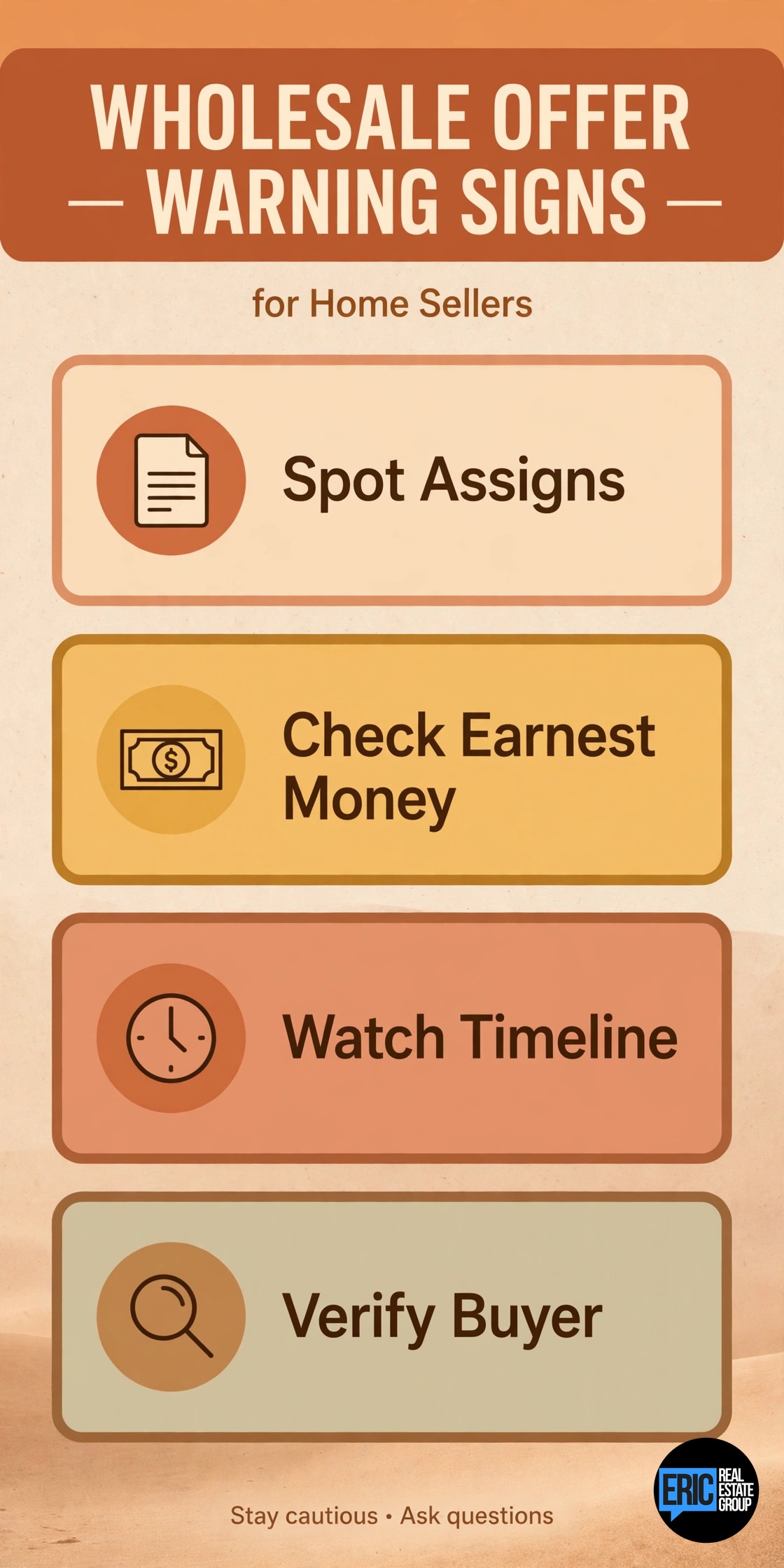
Closing timeline tells that the buyer is shopping your contract
Time is the wholesaler best friend and the seller biggest cost. Your home sits tied up while someone else looks for a buyer, and if they fail, you restart weeks later.
Timeline tells I watch for:
- Closing set 45 to 60 days out, or longer, with no lender reason for the delay, on a claimed cash deal that should be able to close faster once title is clear
- Extensions written in as automatic, or a right to extend for marketing, funding, or finding an end buyer
- A long feasibility, inspection, or partner approval period, sometimes 21 to 30 days, where the signer can terminate for almost any reason and get the earnest money back
- No hard deadlines for proof of funds, assignee disclosure, or deposit, even though your deadline to take the home off the market starts right away
- Pressure to sign today, before you can compare with a listed sale or another cash offer, paired with resistance to shortening the timeline
A real cash buyer can usually explain a timeline in plain terms: title search, payoff, documents, and a firm date. A contract shopper needs time as inventory. If the timeline only makes sense if someone else still has to be found, say so out loud and price that risk, or decline it.
Here is a hypothetical example, labeled as such, with made up numbers for illustration only. A signer offers $180,000 on a Pharr home, puts $100 earnest money down, asks for 30 days to inspect and 60 days to close, and includes "and or assigns" with no consent needed. If they assign to an end buyer at a higher effective price and keep an assignment fee, you still get $180,000 if it closes. If no end buyer appears by day 55 and they walk during a broad termination right, you kept your home off the market for almost two months for $100 at risk. That math is why the deposit and the deadlines matter more than the pitch.
What to do instead if you want speed and certainty
You have options that keep you in control. List the home and invite investor offers alongside regular buyers, with a deadline and proof required from everyone. Or take a cash offer only from the person or company who will close, with assignment prohibited or subject to your written consent, earnest money deposited quickly at a named title company, a short inspection window, and a firm closing date with no automatic extensions.
If you are comparing selling on your own against having representation review these contracts for you, I walk through that trade in FSBO vs Listing With a Realtor in the Valley: The Real Cost Difference. One contract review can save a seller from tying up a home on a contract the signer never planned to close.
Before you sign any wholesale or assignment offer, get in writing: the full legal name of the buyer, whether assignment is allowed, your consent right, the assignee proof you will receive, the earnest money amount and deposit deadline, every termination right and its date, and the exact closing date. If it is not in the contract, it is not promised.
Wholesale offers are not a shortcut around reading. In the Rio Grande Valley, the sellers who do best with investor offers are the ones who check the assignment clause, demand real money at risk, and refuse an open ended timeline.
Looking to buy or sell in the Rio Grande Valley?
Eric Jimenez | Eric Real Estate Group, LLC | 956-292-4500 | eric@bettercalleric.com | bettercalleric.com
Better Call Eric. Listings that sell.
Start Your Search: Rio Grande Valley Homes for Sale
Reading about the market is smart. Looking at real homes is better. Try one of these searches, then create a free account to save your favorites and get new listings emailed to you the moment they hit the market.
- Homes for sale in McAllen
- Homes for sale in Edinburg
- Search all Rio Grande Valley homes
- Find out what your home is worth
See a home you like? Call Eric Jimenez at 956-292-4500 and I will set up a showing.