



Hey, it's Eric.
A few days after you go under contract in the Rio Grande Valley, a thick document lands in your inbox from the title company. Most buyers in McAllen, Edinburg, Mission, Pharr, Weslaco, and San Juan scroll past it. Do not. Reading your title commitment as a Texas buyer is how you catch a wrong name, a missing lot, a lien, or a restriction before closing, while you still have time to object. This guide breaks down Schedules A, B, and C with one example from each.
What a Title Commitment Is, and What It Is Not
A title commitment is the title company's written promise to issue a title insurance policy if the conditions in the commitment are met. It is based on a search of the public records for the property. It tells you who the title company believes owns the property, what it will cover, what it will not cover, and what must be cleared before it will issue the policy.
It is not a guarantee that the title is clean. It is not a survey, an appraisal, or a home inspection. It does not fix problems by itself. It shows you the problems so you can object, ask questions, and get them fixed while the contract still gives you time. For background on the policy itself, read Title Insurance in Texas: Why Buyers Need It.
Schedule A: The Facts of the Deal, Check Every Line
Schedule A states the facts the policy will be based on. Read it line by line and compare it to your contract. Check:
- The effective date of the title search.
- The type of policy and the amount of coverage.
- The proposed insured, spelled exactly as you want to take title.
- The current owner, which should match the seller on your contract.
- The legal description: the lot, block, and subdivision.
Example: suppose Schedule A lists Lot 12, Block 4 in Edinburg, but your contract is for Lot 13. Or suppose it names only one spouse as the current owner when both spouses own the home. That is not a small typo. Get it corrected, because the policy follows Schedule A. If Schedule A is wrong, the policy can be wrong too.
Schedule B: Exceptions, What the Policy Will Not Cover
Schedule B lists the exceptions. These are the matters the title policy will not cover. They stay with the property, so you need to understand them before you close. Common Schedule B items include:
- Deed restrictions that limit how the property can be used.
- Utility, drainage, and access easements.
- Building setbacks, mineral reservations, and leases.
- Matters shown on the survey, which the commitment ties to Schedule B.
For more on that last point, read What Is a Survey in a Texas Home Sale and Why Buyers Should Care.
Example: suppose Schedule B shows a utility easement across the back ten feet of a lot in Mission, along with deed restrictions. That matters if you planned to put a pool or a casita there. You want to learn that during the objection window, when you can still ask questions or object, not after closing when the easement is already yours to live with.
Schedule C: Problems That Must Be Cleared Before Closing
Schedule C lists the requirements that must be satisfied before the title company will issue the policy. These are problems to clear, not exceptions to accept. Common Schedule C items include:
- The seller's existing mortgage or other lien, which the seller must pay off at closing.
- A judgment lien or a tax lien against the property or a party to the sale.
- Proof needed for an estate, a divorce, a company seller, or a power of attorney.
- Marriage, probate, and identity documents needed to prove who can sign.
Example: suppose Schedule C shows an old home equity lien on a home in Pharr. The seller says it was paid off years ago, but the title company still requires a release from the prior lender. Tracking down that lender takes time. In week one it is manageable. Two days before closing, it can move your closing date.
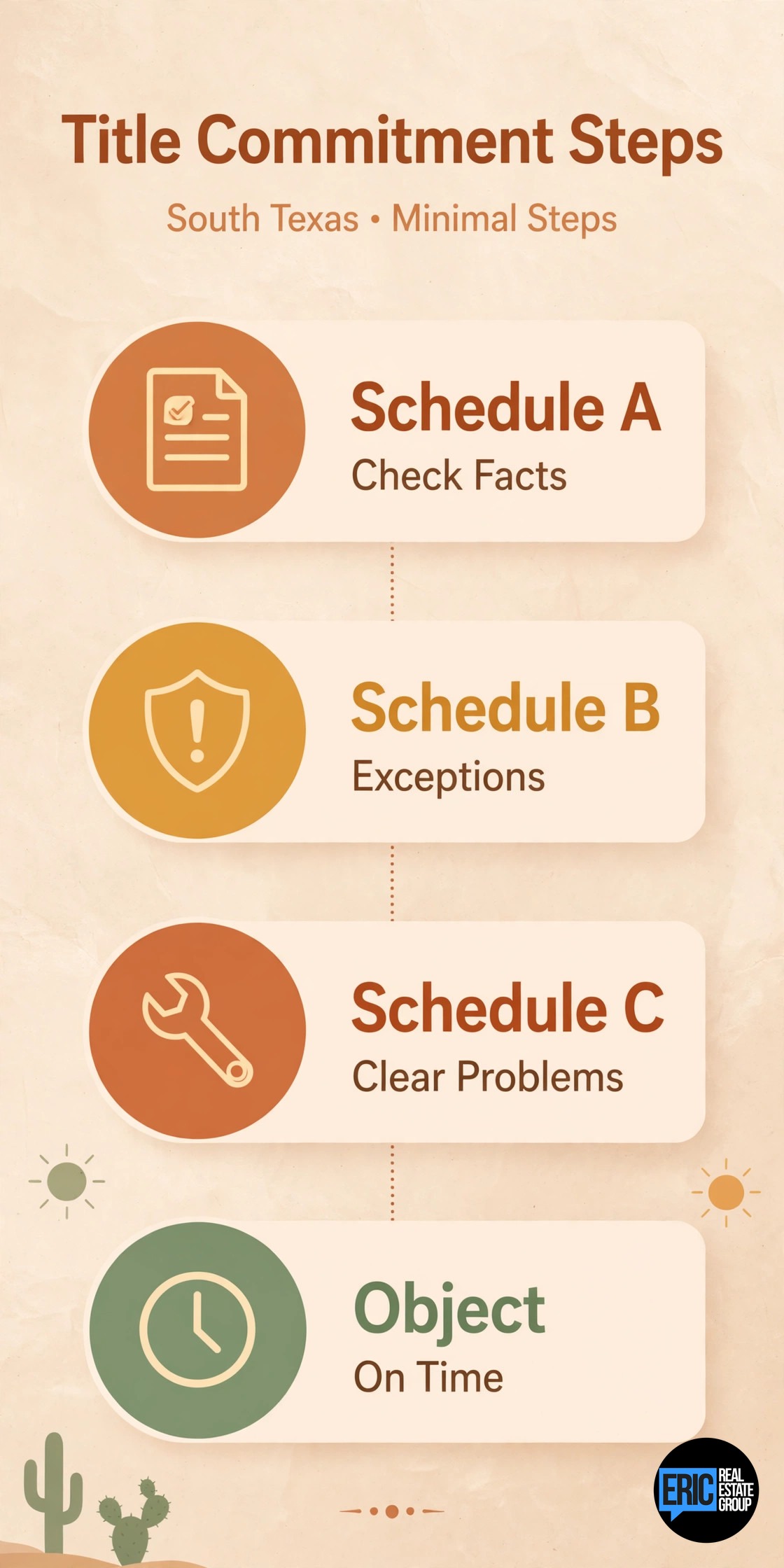
The Objection Deadline Rule Every Texas Buyer Must Know
Under the standard Texas contract, you must deliver your objections in writing within the number of days your contract allows after you received the documents. Count from receipt, not from closing. That deadline is the rule that protects you, but only if you use it in time.
- Read the commitment the day it arrives. Do not wait for a reminder.
- Put your objections in writing, specific to the schedule and the item, and keep proof that you sent them.
- If you miss the deadline, you can be treated as waiving the objections shown, except for items that must be cured for the policy to issue.
- If an item cannot be cured, the contract spells out the next steps, including possible termination within the time it allows.
How to Read Your Title Commitment in 20 Minutes
You do not need a full afternoon. Set aside twenty minutes and work through it in order:
- Schedule A: confirm the names, the seller, the policy amount, and the legal description.
- Schedule B: highlight every exception that is specific to this property, and picture each one on the lot.
- Schedule C: list every document, payoff, and release, and note who handles each one and by when.
- Write your objection deadline on your calendar the day the commitment arrives.
- Send your objections and questions in writing before the deadline.
When closing day comes, you will already know what to expect. Read Closing Day in Texas: What Happens at the Title Company, Step by Step.
Looking to buy or sell in the Rio Grande Valley?
Eric Jimenez | Eric Real Estate Group, LLC | 956-292-4500 | eric@bettercalleric.com | bettercalleric.com
Better Call Eric. Listings that sell.
Start Your Search: Rio Grande Valley Homes for Sale
Reading about the market is smart. Looking at real homes is better. Try one of these searches, then create a free account to save your favorites and get new listings emailed to you the moment they hit the market.
- Homes for sale in McAllen
- Homes for sale in Edinburg
- Homes for sale in Pharr
- Search all Rio Grande Valley homes
See a home you like? Call Eric Jimenez at 956-292-4500 and I will set up a showing.