


Hey, it's Eric.
If you are buying a home in the Valley, you will hear the word survey early, and a lot of buyers nod along without knowing what it is. A survey in a Texas home sale looks boring until it saves you from a fence line fight or a structure sitting where it should not sit. In my experience in McAllen, Edinburg, Mission, Pharr, Weslaco, and San Juan, buyers who read their survey close with more confidence.
What a Survey in a Texas Home Sale Actually Shows
A survey is a drawing prepared by a licensed surveyor that shows the boundaries of the property and where things sit on the land. Think of it as a map of what you are actually buying.
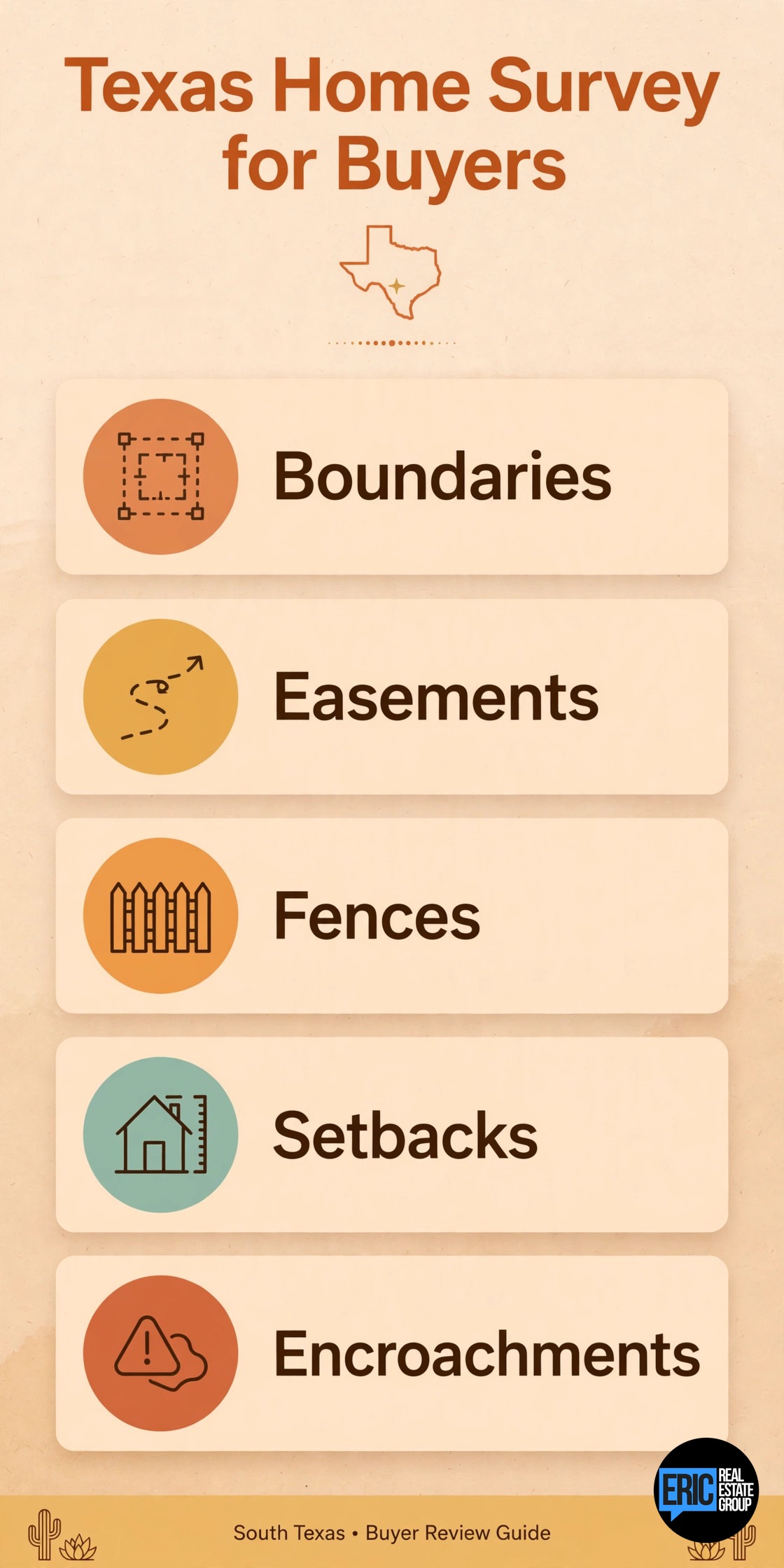
A typical residential survey will show:
- The boundary lines of the lot and the measurements along those lines
- The house, garage, driveway, patio, pool, and other improvements on the lot
- Fences and how they line up with the boundary lines
- Easements that cross the property, such as utility easements along the back or side
- Building setback lines that limit where structures can be placed
- Any encroachment the surveyor can see, such as a neighbor fence or a shed crossing a line
That map matters because the deed describes the land, but the survey shows you the land in real life. A listing photo will not tell you that a fence sits on the wrong side of the line. A survey can.
This is also why a survey works hand in hand with title work. My guide on Title Insurance in Texas: Why Buyers Need It explains how the title commitment flags easements and restrictions on paper, and the survey helps you see where those items fall on the ground.
Why Buyers Should Care About the Survey
Buyers should care for practical reasons, not just paperwork reasons.
You want to know the house and improvements you are paying for are actually on the lot you are buying, whether anything crosses a line or an easement, and whether there are boundary or access problems. Lenders and title companies care for the same reasons before they fund and insure the sale.
In my experience, survey surprises in the Valley often involve the same short list:
- A fence built off the true line, sometimes by a foot or more
- A storage shed, carport, or concrete work placed inside a utility easement
- A gate or driveway apron that does not line up the way the seller described
- A rural property where the old markers are gone and nobody is sure where the line really is
None of those has to kill a deal. Finding them early is the whole point.
Existing Survey, New Survey, and the Affidavit Sellers Sign
Many Texas sales start with a simple question. Does the seller already have a survey?
If the seller has an existing survey, the contract often gives the seller a set number of days to deliver that survey along with a signed affidavit, commonly called a T 47 affidavit, where the seller states whether there have been changes to the property since that survey was done. The title company and your lender then decide whether that existing survey is acceptable for closing.
An existing survey is more likely to work when it is legible and complete, no structures or fences have changed since it was done, the seller can honestly sign the affidavit, and the title company and lender accept it. Order a new survey when the seller has none, the old one cannot be accepted, or the property has changed. Raise the question in the first days under contract, not the last week before closing.
My checklist in Home Inspections in Texas: What Buyers Must Check makes the same timing point for inspections, and it applies here too. The option period is when you investigate. Use it.
What to Check on Your Survey, Line by Line
When the survey arrives, compare it to the property you walked:
- Do the boundary measurements match what you were told, especially on corner and larger lots?
- Is the house inside the lines and clear of setbacks and easements?
- Do fences sit on, inside, or outside the lines?
- Are sheds, pools, and patios shown, and are any inside an easement?
- Does anything from a neighbor cross onto this lot?
- Is there clear access from the street, and does the driveway match?
As a hypothetical example only, imagine you are buying a home in Weslaco and the survey shows the back fence sitting well inside the true boundary, with a strip of the yard actually lying on the other side of the fence. You would want to know that before closing, ask questions while you can still negotiate, and understand what you own versus what you have simply been using.
If something does not make sense, ask early. A short question during the option period is much cheaper than a boundary dispute after closing.
For land, the stakes are higher. My guide on Buying Land in the Rio Grande Valley: What to Know Before You Build covers why boundaries and access deserve extra time.
Who Pays for a Survey in Texas and When It Happens
Who pays is a contract question. The contract spells out whether the seller provides an existing survey, whether a new one is ordered, and who pays. Read that paragraph before you sign.
- Ask on day one whether the seller has a survey.
- Review the survey and affidavit as soon as they arrive.
- Decide quickly if a new survey is needed.
- Review the final survey before closing and raise issues within the time your contract allows.
- Keep a copy with your closing papers for fences, additions, and resale.
I am not a surveyor or a lawyer, and a survey is not a guarantee. It is still far better than guessing where your property begins and ends.
The Bottom Line on Surveys for RGV Buyers
A survey tells you what you are actually buying and where the lines really are. Read it during your option period, ask about fences, easements, and encroachments right away, and order a new one when the old information cannot be trusted.
If you are buying in McAllen, Edinburg, Mission, Pharr, San Juan, or Weslaco and you want help reviewing the paperwork in the right order, call me. I will help you slow down on the documents that matter and keep the closing on track.
Looking to buy or sell in the Rio Grande Valley?
Eric Jimenez | Eric Real Estate Group, LLC | 956-292-4500 | eric@bettercalleric.com | bettercalleric.com
Better Call Eric. Listings that sell.
Start Your Search: Rio Grande Valley Homes for Sale
Reading about the market is smart. Looking at real homes is better. Try one of these searches, then create a free account to save your favorites and get new listings emailed to you the moment they hit the market.
- Search all Rio Grande Valley homes
- Homes for sale in McAllen
- Homes for sale in Edinburg
- Homes for sale in Weslaco
See a home you like? Call Eric Jimenez at 956-292-4500 and I will set up a showing.