


Hey, it's Eric.
If you are shopping for a home in McAllen, Edinburg, Mission, Pharr, Weslaco, or San Juan, Texas property taxes need to be part of the conversation from day one. I see buyers fall in love with a price, run a payment estimate with a generic tax guess, and then get surprised when the real bill for that specific address tells a different story. Texas property taxes can change your monthly payment, your escrow, and whether a home truly fits your budget.
In my experience, the smartest buyers do not ask only what a home costs. They ask what it costs to own, every month and every year.
Why Texas Property Taxes Change the Real Price of a Home
Two homes with the same list price can cost you very different amounts to own. That is because property taxes are set locally, and the total bill depends on where the home sits and which taxing units serve that address.
Here is what that means in plain language.
- There is no single flat Texas rate that applies to every home.
- A home inside city limits is usually taxed by more units than a home outside city limits.
- School district taxes are a major part of most bills, and school districts differ by address.
- Newer subdivisions in growing areas may have additional districts or special assessments that an older neighborhood does not have.
- The county appraisal district puts a value on the property, and your taxes are based on that appraised value multiplied by the combined rates of the taxing units for that address, minus any exemptions you qualify for and actually have on file.
So when you compare homes in McAllen, Mission, Edinburg, or Weslaco, do not compare list prices alone. Ask for the tax history on that exact address and have your lender run the payment with those real numbers.
How Texas Property Taxes Work, Step by Step
Understanding Texas property taxes gets easier when you break it into parts.
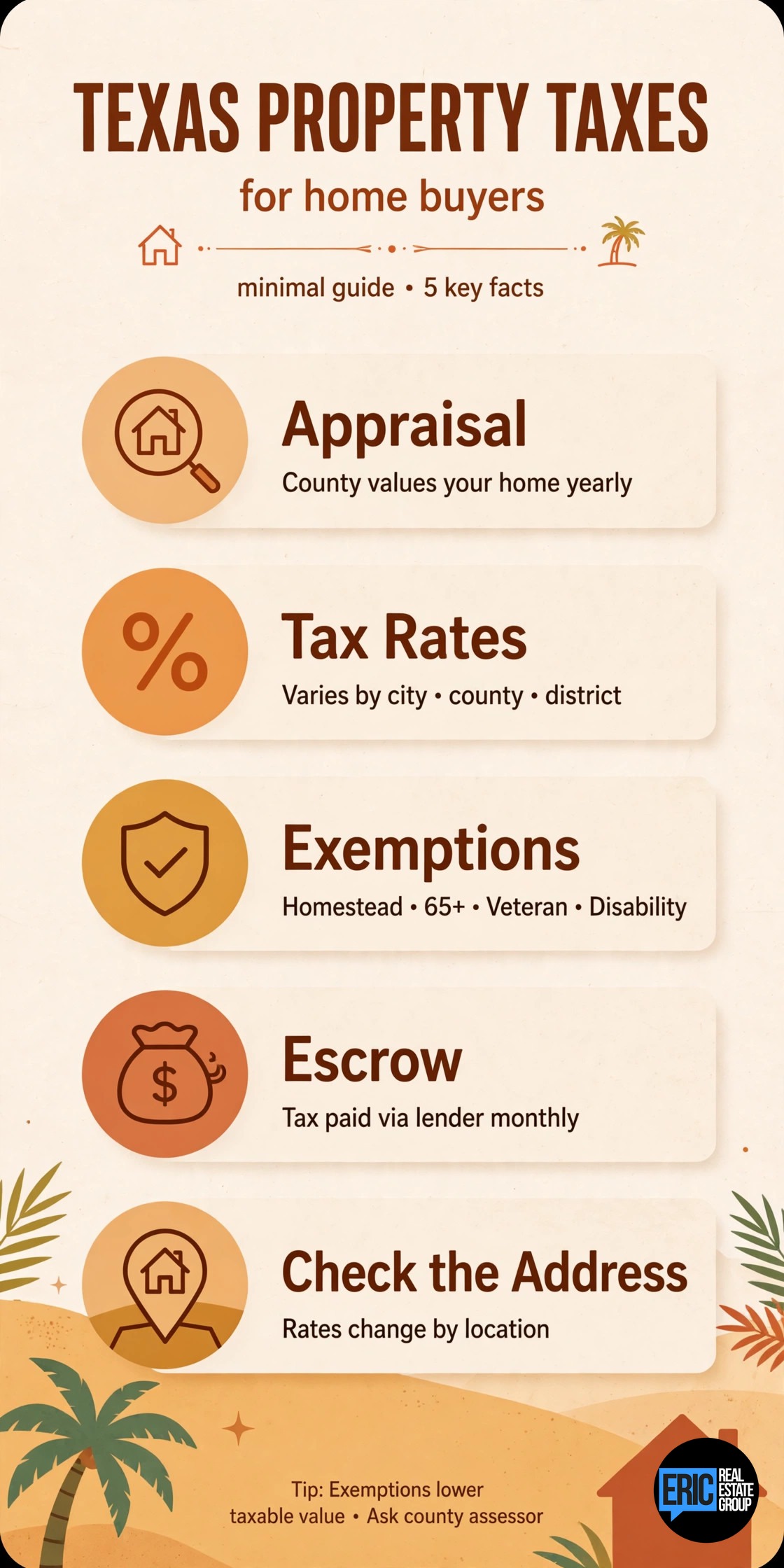
First, the appraisal. In Hidalgo County, the appraisal district values property each year for tax purposes. That value may be close to market value, below it, or above what you think the home would sell for. It is not the same as the list price, and it is not the same as the appraisal your lender orders for your loan.
Second, the rates. Each taxing unit that serves the address sets its own rate. Your combined rate is the total of those units. That is why a few blocks can matter. Crossing a city limit or a school district line can change the bill.
Third, exemptions. An exemption can lower the taxable value of your home. The best known example is the homestead exemption for a home you own and live in as your main residence. There are rules, paperwork, and deadlines, and you have to apply and be approved. Do not assume an exemption the seller has will stay in place for you. Ask.
Fourth, the bill and the payment. Even if you pay taxes through escrow with your mortgage, you are still paying them. Your lender collects a portion each month, holds it in escrow, and pays the bill when it comes due. If the bill goes up, your escrow and your monthly payment can go up too.
Escrow, Prorations, and Why Your Payment Can Change After Closing
This is where a lot of first time buyers get caught off guard.
At closing, taxes are usually prorated between buyer and seller based on the closing date. The seller covers the part of the year they owned the home, and you cover the rest. My earlier guide, What Are Closing Costs in Texas? A Buyer's Line by Line Breakdown, walks through how those closing items fit together.
After closing, a few things can change your payment.
- The appraised value changes. If the value goes up, the bill can go up even if rates stay the same.
- You bought new construction. As a hypothetical example, a new home may first be taxed based mostly on the land while it was being built, and then be reassessed as a finished home the next year. That jump can shock buyers if escrow was set using the lower early number.
- The seller had an exemption you do not have. Your taxable value as the new owner can be different.
- Your escrow was estimated low at the start. Lenders estimate. The real bill settles it, and your payment adjusts.
Leave a cushion in your budget. If a payment only works when taxes stay exactly where they are today, that home may be too tight.
Questions to Ask About Texas Property Taxes Before You Offer
Ask these questions on every home you seriously consider, whether it is in Pharr, San Juan, or anywhere else in the Valley.
- What were the total property taxes on this address last year, and what taxing units were included?
- What is the current appraised value with the appraisal district, and is it higher or lower than the asking price?
- Does the seller have a homestead or any other exemption on file, and will my lender's estimate still work without it?
- Is this home in a special district or a newer subdivision with extra assessments?
- For new construction, was the last tax bill based on land only or on the finished home?
- What will my lender use for taxes in my monthly payment estimate, and is that number based on this address or on a guess?
Those answers tie directly into the bigger budget question in my guide, How Much House Can You Afford in the Rio Grande Valley?. Price, rate, insurance, and taxes all live in the same monthly payment. You cannot judge affordability without all four.
A Few Practical Habits That Save RGV Buyers Headaches
After you close, check with the appraisal district about filing for your homestead exemption as soon as you are eligible, and confirm it shows up the following year. Read your appraisal notice when it arrives each spring instead of tossing it. If you believe the appraised value is too high compared to what similar homes are selling for, Texas gives owners a way to protest that value, with a deadline.
Also, plan for insurance alongside taxes. In south Texas, homeowners insurance and, where required, flood and wind related coverage can move your monthly cost just like taxes do. Get real quotes for the specific address early.
The Bottom Line on Texas Property Taxes
Understanding Texas property taxes before you buy is not about becoming a tax expert. It is about buying with your eyes open. Look at the real bill for the exact address, understand that appraised values and exemptions change when a home sells, be extra careful with new construction, and make your lender show you the payment using real local numbers.
I will pull the tax history with you and make sure the home that fits your life also fits your budget after taxes.
Looking to buy or sell in the Rio Grande Valley?
Eric Jimenez | Eric Real Estate Group, LLC | 956-292-4500 | eric@bettercalleric.com | bettercalleric.com
Better Call Eric. Listings that sell.