


Hey, it's Eric. When buyers in McAllen, Edinburg, Mission, Pharr, Weslaco, and San Juan look at their first mortgage statement, the number that confuses them most is not the interest rate. It is the escrow part. Your monthly payment is bigger than principal and interest alone, and a chunk of it goes into an escrow account, sometimes called an impound account, every single month. Let me walk you through where that money actually goes, so escrows and impounds in Texas stop feeling like a mystery charge.
If you are still budgeting for a purchase, my guide on how much house can you afford in the Rio Grande Valley will help you see why you need to budget for the full payment, not just principal and interest.
What Escrows and Impounds in Texas Actually Are
An escrow account is a holding account your loan servicer manages for you. Each month, part of your payment goes in. When your property tax bill and your homeowners insurance bill come due, the servicer pays them out of that account on your behalf.
In Texas, that matters a lot, because we have no state income tax but we do have property taxes that are billed once a year, usually in the fall, and due by January 31. Your insurance premium is also usually billed once a year. Without escrow, you would need to save for those large bills on your own. With escrow, the servicer spreads them across twelve monthly payments.
Lenders often require escrow, especially on loans with a smaller down payment. Even when it is optional, many of my buyers keep it because it forces the saving to happen automatically.
The Four Parts of Your Monthly Payment
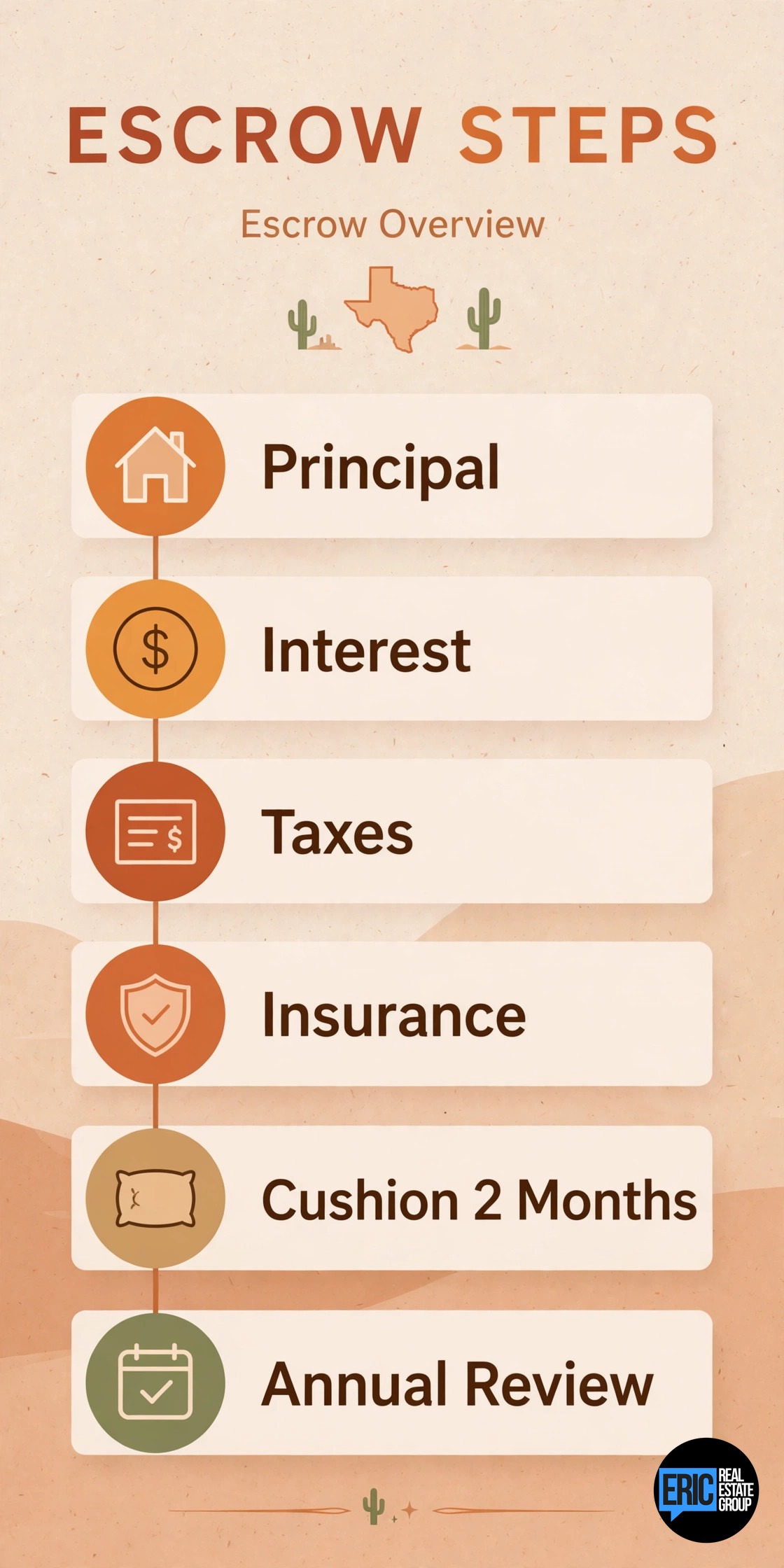
Most buyers hear the phrase PITI. That is principal, interest, taxes, and insurance.
- Principal is the part that pays down what you borrowed.
- Interest is the cost of borrowing the money.
- Taxes is the monthly escrow deposit for property taxes.
- Insurance is the monthly escrow deposit for homeowners insurance, and for windstorm coverage if your policy is separate.
If you have mortgage insurance, that is an additional monthly line. If you have an HOA, that is usually paid separately from escrow, though every servicer handles statements a little differently. Read your first statement line by line and ask your servicer to explain any line you do not recognize.
This is also why understanding Texas property taxes before you buy matters so much here. A home with a higher taxable value or a higher combined tax rate will have a higher monthly escrow deposit, even if the loan amount is the same.
A Sample Escrow Breakdown on a Valley Priced Home
Here is a hypothetical example only, labeled that way on purpose so you can see the math. These are not quotes for any specific home, taxing unit, or insurance policy. Your actual numbers will come from your Loan Estimate, your tax certificate, and your insurance quote.
Imagine a hypothetical purchase in the Valley where, for illustration:
- Annual property taxes are a hypothetical $4,800 for the year. Divided by 12, that is $400 per month into escrow for taxes.
- Annual homeowners insurance is a hypothetical $2,400 for the year. Divided by 12, that is $200 per month into escrow for insurance.
- Combined escrow deposit in this example is $600 per month, on top of your principal and interest.
That $600 is not extra profit for the lender. It is your own tax and insurance money, collected early and held until the bills are due. When you compare homes, compare the tax history and get a real insurance quote early, because two homes at the same price can carry very different escrow deposits.
For a line by line look at what you pay once at closing versus what escrow collects every month, see my breakdown of what are closing costs in Texas, a buyer's line by line breakdown.
The Initial Escrow Cushion Rule at Closing
At closing, you will usually prepay some escrow money upfront so the account starts with a balance. Federal rules allow your servicer to require a cushion, and that cushion is generally limited to two months of escrow payments.
Using the same hypothetical example above, where the combined escrow deposit is $600 per month, a two month cushion would be $1,200. That cushion is there to cover a tax or insurance increase, or a bill that comes due sooner than expected, so the account does not go negative.
At closing you may also prepay the first months of taxes and insurance needed to line the account up with when the bills fall due. That is why the cash to close can feel higher than buyers expect. It is not all fees. Part of it is your own future tax and insurance bills, funded in advance. Ask your lender to walk through the Initial Escrow Account Disclosure Statement line by line before closing day, and keep that page after you close.
Why Your Escrow Payment Changes Over Time
In my experience, the call I get most often in the first few years is this: my payment went up, did my rate change? If you have a fixed rate loan, your principal and interest usually stay the same. What changed is almost always escrow.
Your servicer does an escrow analysis, usually once a year. If taxes or insurance went up, or if the account came up short, your new monthly escrow deposit goes up to cover the shortage and the higher bills ahead. If there is a surplus above what the rules allow, you may get a refund or a lower deposit.
A few Valley specific things drive changes:
- Your home is reassessed after you buy, and the prior owner's exemptions, like an over 65 exemption, may fall off.
- You file your homestead exemption, which can help, but it does not erase the first year adjustment after a sale.
- Your insurance renews at a higher premium, especially if windstorm coverage is part of the picture.
- A new tax year brings a new appraised value from the county appraisal district.
When you get an escrow analysis statement, do not file it away unread. Check the tax amount, the insurance amount, and the projected bills. If an old insurance policy is still listed after you changed carriers, call the servicer and correct it.
Shortages, Surpluses, and What to Do
If the analysis finds a shortage, servicers typically give you options to pay it in full or spread it over the coming months, which raises your payment for a while. If it finds a deficiency after bills were paid from a negative balance, the timeline to repay can be shorter. Your statement will state your options. Read them carefully and ask questions before the new payment starts.
Practical steps I give my buyers:
- Keep a small home reserve even with escrow, so a payment increase is not a crisis.
- File your homestead exemption as soon as you are eligible and confirm the appraisal district received it.
- Shop your homeowners insurance before renewal, and send any new policy to your servicer right away.
- Open every escrow analysis letter and compare it to your actual tax and insurance bills.
Can You Waive Escrow in Texas?
Some buyers ask if they can waive escrow and pay taxes and insurance themselves. Some loan programs and lenders allow a waiver, often only with a larger down payment, strong credit, and lender approval, and sometimes for a fee or a higher rate. Many loans do not allow it at all, especially early on.
Waiving escrow puts the discipline on you. In Texas, that means being ready to pay a full year of property taxes at once in January and a full insurance premium at renewal. If you are great at setting that money aside untouched every month, it can work. If not, escrow is the safer system, in my experience.
Escrows and impounds in Texas are not a trick. They are a budgeting tool built into your loan, with rules on how much cushion your servicer can hold and how your account must be analyzed each year. Once you understand the four parts of your payment, the two month cushion at closing, and why the escrow analysis changes your deposit, your mortgage statement gets a lot easier to read.
Looking to buy or sell in the Rio Grande Valley?
Eric Jimenez | Eric Real Estate Group, LLC | 956-292-4500 | eric@bettercalleric.com | bettercalleric.com
Better Call Eric. Listings that sell.
Start Your Search: Rio Grande Valley Homes for Sale
Reading about the market is smart. Looking at real homes is better. Try one of these searches, then create a free account to save your favorites and get new listings emailed to you the moment they hit the market.
- Homes for sale in McAllen
- Homes for sale in Edinburg
- Homes for sale in Mission
- Search all Rio Grande Valley homes
See a home you like? Call Eric Jimenez at 956-292-4500 and I will set up a showing.